THunder Clouds
Why Oklahoma City Could End Up Reaching the NBA Finals
--------------
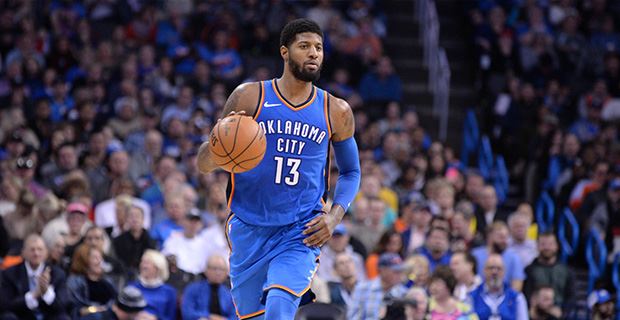
Until this season, it would have been flappable to compare F Kevin Durant and F Paul George; particularly the feats accomplished by Durant during his prime years with both the Oklahoma City and Golden State franchises. From 2013-14 -- Durant's MVP season -- through February of this season, Kevin Durant has averaged 28 points per game on 51/39/88 shooting. There is a legit case to make -- and maybe it will be made one day -- that Durant is the league's best offensive player since Wilt Chamberlain.

It can be argued that Paul George is compiling a season that exceeds any of Durant's. He has elevated what it means to be a two-way player in this league, even eclipsing the merit that (then San Antonio Spurs) F Kawhi Leonard deemed requisite in the mid-2010s when he nearly won both the NBA's Defensive Player of the Year and Most Valuable Player awards. George has had a myriad of incredible performances so far this season. So many that it's difficult to decide the mark that would be deemed his "season-defining performance". A month ago against conference rival Houston, he shot 55% from the field -- on 6/14 from three-point range -- and finished with 45 points and 11 rebounds to surpass MVP contender James Harden for a five-point win. Just a game later against the Blazers, George finished with 47 points and a triple-double in what still is the Thunder's most critical win -- the Thunder beat the Blazers in all four matchups this season; both teams are nearly tied in the Western Conference standings and final playoff seeding could come to a tiebreaker. Paul George has had 7 games with 40 or more points, and in each of those performances he has shot at least 50% from the field and 38% from outside. To boot, George is averaging 2.3 steals per game -- best in the entire league and a career mark.

George is an encapsulation of a Thunder team that has had success, a rollercoaster couple of seasons, and a final ascension towards what could be the peak of both the Thunder and George's decade in the NBA. Durant's Thunder and George's Indiana Pacers were quite literally the second and third best teams during the 2012 and 2013 NBA seasons -- with the Thunder making the 2012 NBA Finals and the Pacers losing in seven games to F LeBron James' Miami Heat in the 2013 Eastern Conference Finals. George suffered the greatest setback of his short professional career in 2014 when he broke his leg during a USA Basketball internal scrimmage. The Thunder -- or at least specifically in the eye's of the organization and their fans -- suffered their greatest "loss" when Durant chose Golden State in free agency during the summer of 2016. Three seasons later the Thunder are once again positioned atop the Western Conference; eyeing the exact same prize that eluded them in 2012.
Nationally, the 2018-19 season was declared incontestable once again when free-agent All-Star C Demarcus Cousins chose to bet on himself and sign a minimum contract with the Warriors after tearing his achilles in February 2018. If the Warriors had dominated the NBA since Durant's arrival, why wouldn't the addition of a fifth All-Star on the roster cement a Golden State three-peat? It's a fair point to make, given that the champion is traditionally the most talented team. But it's also true that few could have predicted the season would play out like it has thus far for the Warriors. Kevin Durant's impending free-agency -- likely the last of his prime -- has provoked contention among members at all levels of the organization, and all to frequently the Warriors play with a malaise we haven't experienced during the Kerr era. G Stephen Curry, G Klay Thompson, and F Draymond Green have all missed games due to injury at inopportune times against the league's best opponents. The remainder of the roster -- outside of F Andre Iguodala and C Kevon Looney -- has been a non-factor on a nightly basis.
The Warriors have had tumultuous stretches during their reign over the NBA, which began in 2015. Every championship team, and even dynastic team, does. In the 2015 playoffs, Golden State trailed Memphis in the Western Semifinals and Cleveland in the NBA Finals. In 2016, they lost the NBA Finals to F LeBron James and the Cavaliers. And in 2018, the Rockets forced the Western Conference Finals to seven games before ultimately falling to the Warriors on their home floor in Houston. But none of those opponents -- including the 2016 Cavaliers that ultimately defeated the Warriors -- were as good of a matchup against Golden State as the 2016 Thunder; Durant's final season in Oklahoma City. And many of the tactics employed by Head Coach Billy Donovan - the Thunder's coach then and now -- can be recycled and reapplied by the 2019 Oklahoma City Thunder in a prospective matchup against the Warriors this postseason. In other words, Donovan and the Thunder do hold the NBA's only blueprint to stopping the Golden State Warriors.
There is a lot to be learned from a deep dive on the 2016 Western Conference Finals -- one of the best playoff series of this century, and arguably one of the best matchups of all-time. Using the Four Factors -- Dean Oliver's formula to basketball success -- we can see that Oklahoma City understood and performed ably enough to win the series. The Warriors just shot better at critical times -- something they have and will continue to do given they have three of the greatest shooters in NBA history on their roster.
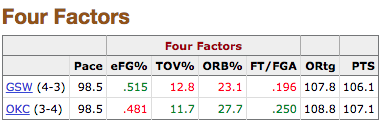
The Thunder even had a better offensive rating (points scored per 100 possessions, in the above graphic columned as "ORtg") than the Warriors on the series. Except when it mattered most. Those who watched the series remember that the Thunder took an emphatic three games to one lead over the 73-9 Warriors, before losing three straight and the series. In each of those last three deciding games, Golden State's offensive rating was better than the Thunder's. This is the first key to obtaining a series win over the Warriors: offensive consistency. The Warriors will undoubtedly have a supernova performance from at least one of their stars in any given seven-game series -- one beyond the control of the opposing defense -- but the key to contending with the Warriors is for the opposing team to keep their own consistency and to play to their desired offensive style, regardless of the score or matchups.
In the 2016 series, the Thunder understood and emphasized the two other keys to contending with the Warriors: forcing turnovers and controlling the glass. Turnovers, represented in the column "TOV%" above, is a measurement of a team's turnovers per 100 possessions. Turnovers, specifically during the Steve Kerr era, have always been the Warriors' achilles heel -- they love to play freely and share the ball, often leading to higher turnover totals per game. The Thunder were tremendous at forcing the Warriors into give aways during that 2016 series, and not surprisingly, this year's Thunder force their opponents into committing more turnovers than any other team in the NBA -- 17 per game!

Heading into the 2019 postseason, the Thunder match up with the Warriors as well as any team defensively -- Paul George is one of a handful of players who can actually contest a Kevin Durant jump shot, G Russell Westbrook is athletic enough to hound Curry when he doesn't have mental lapses, and F Jerami Grant and C Steven Adams have the versatility and physicality to bruise with C Demarcus Cousins and Green inside. Forcing the Warriors out of their rhythm can be incredibly invigorating for an opponent's success on the other end of the floor as well, since Golden State often plays with their emotions on their sleeve and occasionally loses their composure -- the Warriors have amassed more technical fouls than any other team this season.
But ultimately the single greatest kryptonite for the Golden State Warriors is strong rebounding. Rebounding is controlling the possession - when it ends for the other team and when it begins for yours. The Thunder knew during the 2016 conference final series that they had a size advantage -- the Warriors customarily relied on their "death lineup" in the playoffs that postseason; composed of five players 6'8'' and shorter -- and intentionally used it to dominate both the offensive and defensive glass. Since the Warriors play what is referred to as a free offense -- taking principles from Tex Winter's "triangle offense" and the Princeton offense -- they need tempo and constant movement to excel. Rebounding disrupts this flow and enervates players who excel under this style of offense, which gave the Thunder easy points as a result of offensive rebounds and took opportunities away from the Warriors best shooters early on in the series. Kerr and the Warriors were eventually able to revise their style to account for this disruption, but the league and its fans were given a glimpse of understanding at how to challenge the Warriors.
Currently, the Thunder sit as the fifth seed in the Western Conference -- meaning they would matchup against the Warriors in the Conference Semifinal series rather than the Finals -- if Golden State were able to fend off the Denver Nuggets for the first overall seed. This could be beneficial for the Thunder if the Warriors malaise continues into the playoffs' first round, resulting in the Warriors coming into a potential matchup against Thunder without the momentum they so often rely on as fuel for competition. It seems far-fetched to talk about the Thunder contending with the NBA's best team this decade before they even make it out of the first round -- the Paul George iteration of the Oklahoma City Thunder has not yet won a playoff series. And the Thunder have an uphill battle to fight before they even have the opportunity to square off against Golden State; facing another premier conference opponent, potentially without home court advantage in the first round. But like in 2016, the Thunder possess the outfit and understanding for contending with the league's best team. It would be fraught to predict any downfall of the Warriors against any opponent, but don't be shocked if the Thunder accomplish the impossible.
REVENGE GAME
Why the Virginia Cavaliers Could Be Cutting Nets Soon
--------------
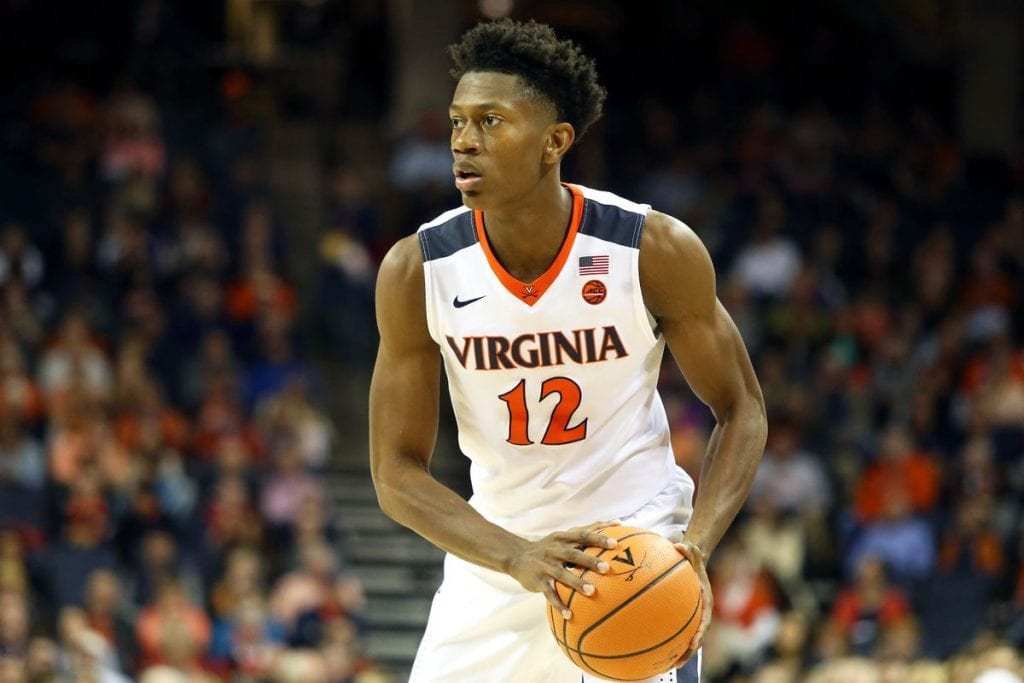
The University of Virginia Cavaliers were the butt of every joke imaginable last March. That's what happens when you are the first NCAA Tournament #1 seed (let alone, the tournament's overall #1 overall seed) to lose to a #16 seed. The talent disparity between last year's Cavaliers and the UMBC (that's University of Maryland - Baltimore County) Retrievers is immense. Virginia has multiple players receiving NBA consideration who were in uniform last season (F De'Andre Hunter, G Ty Jerome, and G Kyle Guy, to name a few). UMBC has sent two players to the NBA in their program history, the last one coming in the ninth round in 1983. But this isn't last season; and Virginia isn't showing the same malaise they exhibited in January and February 2018. This year's team is conspicuously driven, even if their recipe for success remains the same.
The current Cavaliers' style is similar to past seasons, exemplifying Head Coach Tony Bennett's team defensive principles and ostensibly "antiquated" halfcourt offense. But look at the numbers, and you'll actually find the inverse -- an incredibly modern style of play similar to the 'small ball' lineups exemplified by the majority of successful teams in the NBA. Bennett's Cavaliers are #1 in the country in total turnovers, an almost confounding statistic that seems improbable given his preferred style and pace of play. Virginia is also #11 in the country overall in three-point percentage, making exactly 39% of their attempts. NBA marksmen with these kinds of percentage usually take home annual eight-figure paychecks. On defense, they've given up the least shots in the country, on only 45% from two-point range (3rd overall), 28% from three (1st overall), and 66% from the free-throw line (1st overall, as well).
Those numbers are hard to digest and almost seem inflated and erroneous, but they aren't. Bennett's teams have always defended well, and had talented offensive players to provide an additional insurance on the other end of the floor. While none of Virginia's top talents are elite enough to be considered individual phenoms (like any of the given freshmen from Duke, for example), they all focus on their strengths and understand how to put their teammates in a position to excel, given their respective strengths. Last week's win over in-state rival Virginia Tech was a crash-course in everything that makes Virginia so damned deadly as a group.
predicting the western conference
Determining the Strongest Teams in the Stronger Conference
--------------
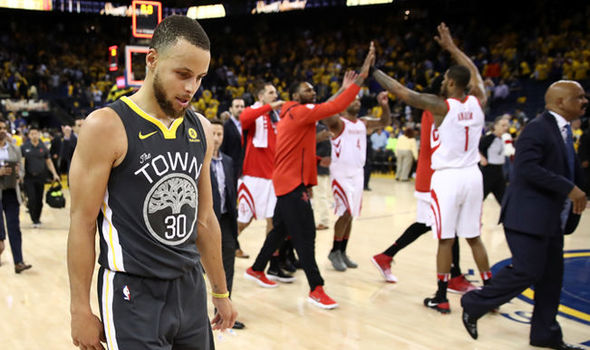
Usually by the midway point of the NBA season you have developed some semblance of intuition about where each team is going, and how the respective conference playoff pictures will come to form. We still know which teams have a realistic shot to vie for an NBA championship, but trying to predict which of the fourteen teams -- sorry, Phoenix -- will reserve one of the Western Conference's eight available playoff seats is anything but easy.
There is a good chance we won't know the true group of eight until the last day of the season, but this is the best attempt to look into the playoff 'mirror on the wall' three months early. The projections below will undoubtedly be fallacious to some degree in the spring.
Here we go:
Which of the teams that are currently projected outside the playoff picture, according to FiveThirtyEight.com, has the best chance at upsetting the odds?
FiveThirtyEight's Western Conference playoff misses list -- which includes the Lakers, Pelicans, Timberwolves, Grizzlies, Mavericks, Kings, and Suns -- is fairly congruent with the preseason projected conference standings. One of two teams on that list that was projected to fall within the playoff picture by Follow Your Shot is the Pelicans, who have had by far the strangest season of any team in the Western Conference given the looming Anthony Davis trials. The numbers behind New Orleans' season are a bit of an aberration. For starters, their net rating is a +2.2 -- meaning on the season they have outscored their opponents on average by 2.2 points -- yet through forty-six games their record is sub-.500 at 20-23. A net rating in the range of +2.2 would project the Pelicans to finish with roughly forty-five wins overall -- putting New Orleans right on the cusp of the playoff picture in the West, where current projections show a requisite forty-six wins to seal one of the eight conference slots. Ultimately, the choice comes down to Davis' current team and his rumored future team, the Los Angeles Lakers, elected by Follow Your Shot as the lucky final recipient of a playoff berth. Based on the first half of the season 'eye test', the Lakers seem like the more cohesive unit with a deeper roster behind their superstar principal -- F LeBron James. Given that the Pelicans' two best players -- Davis and G Jrue Holiday -- have been incredibly injury prone over the past three seasons, the smart choice would be to go with the Lakers over the Pelicans in this case.
Which team is the best in Texas?
While the answer to this question appears salient, don't brush off the premise without first entertaining the question. Since December 1, two of the hottest four teams in the Western Conference are the San Antonio Spurs and the Houston Rockets -- the other two being #1 and #2 in the conference standings overall, the Warriors and the Nuggets, respectively. The impetus behind this question points to two great discourses taking place across the league right now: that James Harden is the decided MVP favorite in January, and that the Spurs' magical elixir of overachievement has not run dry -- as many had predicted it would this season. While the answer may be as simple as the stronger Rockets team being depleted by injuries, there are some idiosyncrasies with the Spurs style of play that contradict the modern movements in basketball. The Spurs are the #1 offense in the league during the aforementioned stretch, even though they are famously now last in the league in shot attempts from beyond the three-point line. Both of the Spurs' All-Stars -- F Lamarcus Aldridge and G Demar Derozan -- thrive on a steady diet of long two-point jump shots. Head Coach Greg Popovich continues to implement and instill team values, regardless of the talent or style of play his group prefers. It may seem like a no-brainer at face value, but do not underestimate Greg Popovich, the San Antonio Spurs, and their roster of misfit servicemen.
Who is the second best team in the West?
As the standings sit today the Denver Nuggets are the second best team in the West. But are we certain they'll be contending for a conference championship? Nuggets Head Coach Mike Malone improbably turned the Nuggets from the 25th ranked defense last season, into a top-10 outfit thus far this season. The other conference contenders looking to sneak into the finals are the Houston Rockets (mentioned above) and the Oklahoma City Thunder -- who sport the league's best defense, allowing only 100.3 points per 100 possessions. F Paul George has surmounted from his gruesome leg injury four summers ago to become a top-10 NBA player once again. Unfortunately, G Russell Westbrook may be on his way out of the league's upper echelon. Yes, he's still averaging a triple-double, but he's also shooting 42/23/63 on the season -- figures that, for a guard, can render you unplayable in the biggest moments. Based on their defensive success and playoff experience, Oklahoma City is the Western Conference's consolation prize winner, until we see signs of a healthy and engaged Rockets team again.
Will all five Pacific division teams make it to the postseason?
This has only happened twice in NBA history (since league expansion to thirty teams, and five teams per division) and the most recent time that it occurred was in 2015 when the entire Southwest division succeeded to the postseason. This season, it seems unlikely given the sheer number of teams that are battling for the other playoff spots. But if any division were able to make a case, it would be the Pacific. The division's weakest link is the Minnesota Timberwolves, who carry a lot of baggage into the second half of the season -- they have the 10th hardest strength of schedule remaining, they made an unexpected coaching change just three weeks ago, and their defense has been unnerving at best and nonexistent at worse. Yet, they still sit just 2.5 games outside the playoff picture today. And even getting 80% of a single division's teams into the playoffs is an impressive feat, and the rest of the Pacific's nominations are all squarely in the conversation. The Jazz have the easiest strength of schedule remaining, and a phenomenal defense anchored by C Rudy Gobert. The Blazers, Nuggets, and Thunder are all in the upper half of the Conference standings along with the Warriors -- though these things seem to change on a nightly basis. G Damian Lillard, C Nikola Jokic, and F Paul George are almost all certainly locks for an All-NBA award, and if they are able to elevate their play for the remainder of the season, their respective teams will be playoff locks as well.
Where will the chips ultimately fall? Can anyone contend with the Warriors?
Predicting the final playoff standings in the Western Conference is guaranteed to cause a headache. There is so much talent, and an abundance of internal contests remaining to be waged, which are likely to continue up until the last day of the season. Through 45 games, we can almost certainly put Golden State as a lock -- given they're currently the #1 overall seed and made the previous 4 NBA Finals. The second tier encompasses a group that would have a legitimate chance of competing with the top of the East -- this would include a healthy Rockets team, the Nuggets, and the Thunder. All three have an explosive offensive star capable of carrying their respective team and controlling the final seconds with the game on the line. For the Nuggets -- whose young core has yet to reach the playoffs -- to be seen as a threat in the West, Jokic will have to continue asserting his presence and demanding the ball (no more of this, Nikola). With half of the available slots presumed full, there remains a middle multitude of hopeful playoff teams -- the Blazers, Clippers, Lakers, Pelicans, Spurs, and Jazz -- in no particular order. The group is divided into three factions: the defenders (the Lakers, Jazz, and Blazers), the scorers (the Clippers and Pelicans), and the Spurs (how one would define the black box that is San Antonio, seems undoable). If you're counting, that means that two teams from this tier -- to be divided into the 'haves' and 'have nots' over the next three months -- will not be apart of the 2019 NBA Playoffs. Given that we have already deemed the Lakers worthy, that leaves just three of the remaining five applicants for consideration. This is the best articulation of how the 2019 Western Conference playoff picture will come to form:
1. Golden State - if healthy, no team in the conference will contend.
2. Oklahoma City - their defense, Paul George's emergence, and Westbrook's regression to the mean will push them to the finish line.
3. Denver - hopefully not a "regular season team", with the Jokic and G Jamal Murray tandem leading the way.
4. Houston - the back-to-back MVP and a healthy contingent of above-average role players will secure home-court advantage and a second round rematch of last year's Western Conference Finals.
5. Utah - the system and defensive personnel will get the Jazz into the playoffs, but won't be enough to get into the conference's upper half.
6. San Antonio - another year of defying the odds, and a first-round matchup with Denver may give the Spurs the advantage in the first-round.
7. Portland - Lillard will be enough to keep the Blazers in, but it will be tough to escape a first-round exit once again.
8. Los Angeles Lakers - ditto for James, and a matchup with the Warriors will be must-see television.
Regardless of the individual matchups, each round of the Western Conference postseason will be a fascinating push-and-pull of great coaching, individual talent, and high-level crowd atmospheres. And the picture continues to change every day, making these next three months a mock trial for the intensity we'll get to live every night starting in April.
Measuring Defense: part 1
The 2018-19 Season The Next Frontier of NBA Analytics Will Come on the Defensive End
--------------
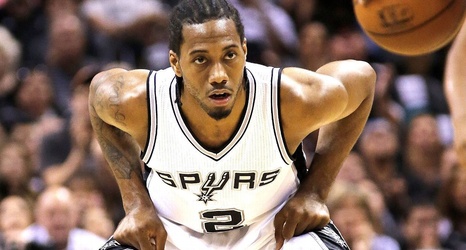
"Get down in a stance!"
"Talk!"
"Defense wins championships."
These are tenants drilled into each player from their basketball infancy. And the last one may be the most insightful and clairvoyant sentiment that can be disseminated from teacher to student. Basketball is a beautiful game because multiple minute games within the game are being played simultaneously. In the grand scheme, it is hard to isolate one facet of the overall sport that drives success, but there a wealth of evidence that conveys that defense highly correlates with winning. Mainly because defense impacts other dimensions of the game directly. If a team plays good defense consistently, they get better offensive opportunities because their opponent does not have additional time to prepare their own defense blockade. When all five players are in good defensive position -- loosely defined here as each player being: 1) between their man and the basket, 2) active (i.e. moving), 3) with their hands up and their head on a swivel -- they are in optimal formation to secure a defensive rebound and advance the flywheel on offense. Good defense also dictates pace, or the speed at which the game is played -- measured in possessions per 48 minutes -- which is incredibly impactful in the NBA game today.
At the professional level, we may be at the apex of offensive efficiency - the shooters are the best in league history, the players have more room and freedom, and the decision-makers within each organization have more information from which to make their decisions than ever before -- "analytics", as it is often termed. As a result, the game has drastically changed in the last five years defensively. Teams are comfortable switching across all positions; 7-footers do not see the floor, or have any impact, unless they have some semblance of guard-like skills; and decisions are made on the fly, without "a script set for it" as Golden State Warriors Assistant Coach and defensive guru Ron Adams said last month in an interview with The Ringer's Justin Vierrer. So if defense is such a necessity in today's game, why is there still no strong quantitative way to effectively measure NBA defense?
Our assessment can begin with the basics of defensive structure and assignment. Traditionally, defensive schemes adhere to the principle that each player has to be able to "guard their position" (i.e. guards match up with fellow guards, forwards take forwards, centers on centers. With some small fluctuations). Guards have to be quick enough to keep up with other guards, forwards need to be versatile enough to match up with the mirage of other swingmen, and centers need to be strong enough to battle and bruise with other gargantuan bigs. If a player displays this positional necessity, then the next step is building defensive instincts -- the ability to know when to help a teammate, rotate to take an open shooter, and box out when a shot is attempted. This is commonly referred to as "team defense". If a player has not mastered the ability to adhere to these team principles, they either do not survive at the professional level beyond their initial contract or are historically great on the offensive end. And this may target the most important aspect of defense: one weak link in a five-man army is sufficient fodder for the best coaches and the best talent on the planet to exploit and harass. Defense is so hard to measure because -- even more so than professional basketball offense -- is is truly a team endeavor.
Comb through team-based or individual defensive metrics and advanced statistics, and it is easy to find litters of information that would confound the long-established "eye test". In 2016-17, before Kawhi Leonard's feud with the San Antonio Spurs that landed him in Canada, Leonard was the two-time defending NBA Defensive Player of the Year and a strong candidate for the league's Most Valuable Player award as well. Through twenty-four games that season, Kawhi's defensive rating -- a figure conveying the points the opposition scores per 100 possessions when Leonard occupies the court -- was the lowest on the entire Spurs roster at 106.3. That is not small sample size theater, but rather a legitimate statistic confounding the long-held unanimous belief that Leonard is one of the greatest perimeter defenders in NBA history. But obviously it is well-known that Leonard is a top-three defender in the league, and by far the best defender on the 2016-17 San Antonio outfit.
So what gives? And what can this tell us about defensive statistical analysis in the NBA? Firstly, it teaches us that we must use extreme caution when consuming advanced statistics and pure quantitative measures of basketball impact at face value, in any situational context and with any players or teams. There should always be a harmony between our study of these measures and our reliance on the empirical knowledge gained from watching games first-hand. But more directly, it should teach us that we do not have as impactful a method for isolating and measuring defensive impact as we do for other aspects of the modern NBA game, such as rebounding and offensive efficiency. However, there are measures currently available that can give us a better understanding of defensive impact in an NBA game; which may serve as a prescient model for measuring defense in a highly-analytical level in the near future.
Deflections
Deflections is one of the most basic, yet incredibly valuable measures for assessing defensive effectiveness in basketball. A deflection is any time that a defender uses part of their body (usually hands or arms) to impede the progress of the ball towards its intended target (basket or teammate). Former University of Louisville Head Coach and Member of the Basketball Hall of Fame Rick Pitino was once quoted as saying "If you get 35 deflections, you're going to win 95 percent of your games". Deflections are valuable not only because they can lead to a turnover in the form of blocks or steals, but because they disrupt the progress of an offensive possession, which is typically sufficient to cause the opposing team to either settle for poor shot selection -- and thus, make fewer baskets. Deflections also inspires the defensive team and conveys that putting in tedious effort like staying in a defensive stance, or keeping your hands out and active, can have a tangible impact on the outcome of games. Suddenly, a unit with little movement and purpose is injected with vigor. This clips shows former University of Kentucky National Champion F Terrance Jones -- who had stints in the NBA with the Rockets, Pelicans, and Bucks -- create a deflection and ignite guards Marquis Teague and Doron Lamb into the open court. This got both the Wildcat players and fans more engaged and excited about the ensuing possession. That translation towards subsequent plays is the visceral impact of deflections that make them so incredibly valuable.
Shot Profile
The most effective defensive tool in the current analytical toolbox comes from analyzing an opposing team's shot profile, and tailoring gameday strategy towards that team's shooting weaknesses. NBA shot profiles can be easily digested using a short chart -- a heat map diagraming a particular player or team's effectiveness from each on the floor. Here is an example chart from an old Los Angeles Clippers team:
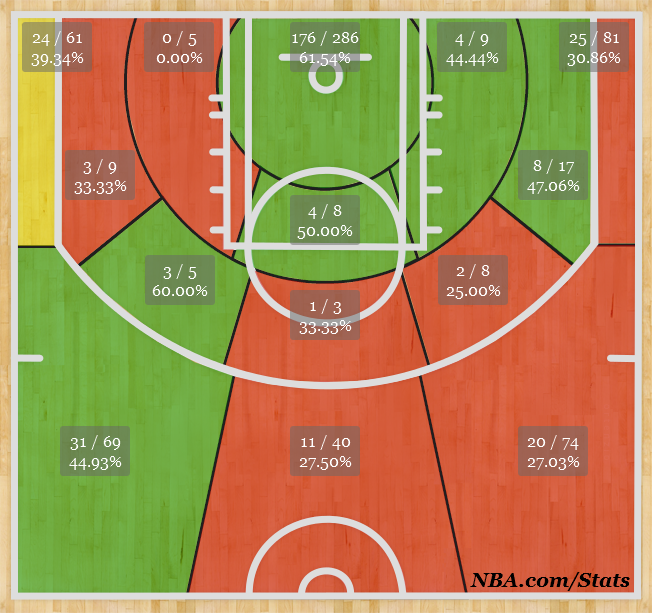
This diagrams breaks the halfcourt into a few select digestible areas that are sufficiently common in distance and position relative to the basket. The first is the restricted area, which is that section of the floor closest to the basket that commonly represents attempted layups, post-ups, dunks, and offensive rebounds. The second area is the non-restricted area key, which makes up the remainder of the key -- the rectangular section of the court between the basket and the free throw line that extends eight feet in each direction from the rim -- that does not also comprise the restricted area. Then the midrange is divided into the "near midrange" and "long midrange" -- representing the area between the key and three point line -- with ranges of 8 feet to 15 feet and 15 feet to around 23 feet, respectively. And then the three-point shot profile, which is divided into three categories: corner threes, non-corner below-the-break threes (simply referred to as "below-the-break threes"), and above-the-break threes. Corner threes are exactly what they sound like -- they are those three-point attempts taken in the two corners of the halfcourt. These shot attempts are incredibly important because they are the shortest distance to the basket (22 feet) that awards three points, and thus the most effective field goal attempts an offensive team can take from outside. The break defines the free-throw line, extended across the half court to each sideline to form a parallel line with the baseline and half-court line. The below-the-break threes are those taken on the side of this "break" line that are closer to the basket, and the above-the-break threes are those taken farther away.
When coaches and players prepare their defense for a given matchup, they will obviously tailor their defense to the areas on the floor that the opposing team struggles with (for example: using only the shot chart above a coach might recommend forcing the Clippers to shoot on the right side from beyond the arc and from the long mid-range areas on the court). As a hard and fast rule, coaches typically try to force attempts above the break and from the mid-range -- since shot attempts closest to the basket are the most efficient, and corner three-point attempts are the most effective shot attempt in the game given their distance and the additional point rewarded for made baskets. The most effective way to use shot profiles in making defensive assignments is looking at individual players' tendencies and weak areas, and trying to force players to shoot from said areas (for example: a coach might instruct their hypothetical perimeter defenders to force the Clippers' guards towards the right-side of the floor, in hopes that they continue to take and miss shots from their "weaker" side of the floor).
Contested Shots
Anyone who has played basketball knows that it is much harder to shoot with a hand in the face, and this holds true for even the best players in the world. With advances in technology and a growing interest in statistical analysis to drive decision-making, new opportunities have opened that provide greater access towards how NBA front offices and coaching staffs consume and drive their decisions day-to-day. One such technology is Second Spectrum, an analytical toolkit that uses a multitude of cameras setup in the arena to display outcomes based on circumstantial factors. For basketball, these factors can include situations with a multitude of variables, like: shot distance, shot angle, closest defender, shot type, and how a player succeeds in each of the above given situations. Not surprisingly, this technology has provided teams with a mass of evidence that show how a player performs when their nearest defender contests a shot attempt, from any distance desired. When measuring these shots, we can see that active defensive instincts and a prudent use of structured contests drives defensive value; and winning, ultimately.
This is part one of a two-part series, check for part two coming shortly.
Season preview for the casual Nba fan
The 2018-19 Season
--------------
Teams
In alphabetical order, skip to your favorite
Atlanta Hawks
Summary: 15th in the Eastern Conference, Lottery-Projected
Trae Young and John Collins make for the most-exciting duo on a sub-thirty win team. Young has already shown his ability to put up strong numbers, and is a semi-strong Rookie of the Year candidate. Watch for F Taurean Prince to have another solid under the radar year; he could be a desirable trade candidate for back-end Western Conference teams looking to add defensive versatility for the playoffs (but Atlanta will not deal him unless the pot is sweetened with draft picks). Also, Jeremy Lin and Vince Carter are teammates.
Boston Celtics
Summary: 2nd in the Eastern Conference, 2019 Eastern Conference Finals
Nothing new to comment on that hasn't already been said; their true potential is a conference contender and their ceiling is a championship. The 2018-19 season will not be end in despondency, the Celtics will challenge the Raptors and Warriors for the title this season, if not win the whole damn thing. A roster with this kind of depth and a coach this talented is the exact concoction that could trigger a shift of the guard. But I like the Raptors' chances slightly better (see below). The best bench in the NBA by far -- although G Terry Rozier is one of the more-overrated players in the NBA following last year's playoffs -- and the additions of healthy versions of G Kyrie Irving and F Gordon Hayward give this team a plethora of offensive creators to go to with the game on the line. The Celtics also get the Sacramento Kings' (see below) pick if it not the first overall pick, and the new lottery reform provides the Cs with even greater odds of receiving said pick.
Brooklyn Nets
Summary: 11th in the Eastern Conference, Lottery-Projected (Have a pick!)
Yes folks! That is not a typo above! The Brooklyn Nets do in fact own their first-round pick with zero protections involved. They can actually start beginning to build their future roster! All jokes aside, the Nets have done as close to an A-level job of building their current roster given the debacle of 2014. Sophomore C Jarrett Allen is a bona-fide big man, and will almost certainly make an All-Star team if he remains in the Eastern Conference during his prime. G Spencer Dinwiddie is the best guard in the league that nobody has heard of, and free agent addition G Shabazz Napier will provide a nice scoring punch off the bench. If Head Coach Kenny Atkinson can continue instilling a tight-knit culture within the Nets' locker room, they will be a solid up-and-coming team within the next two seasons.
Charlotte Hornets
Summary: 8th in the Eastern Conference, First-Round of the Eastern Conference Playoffs
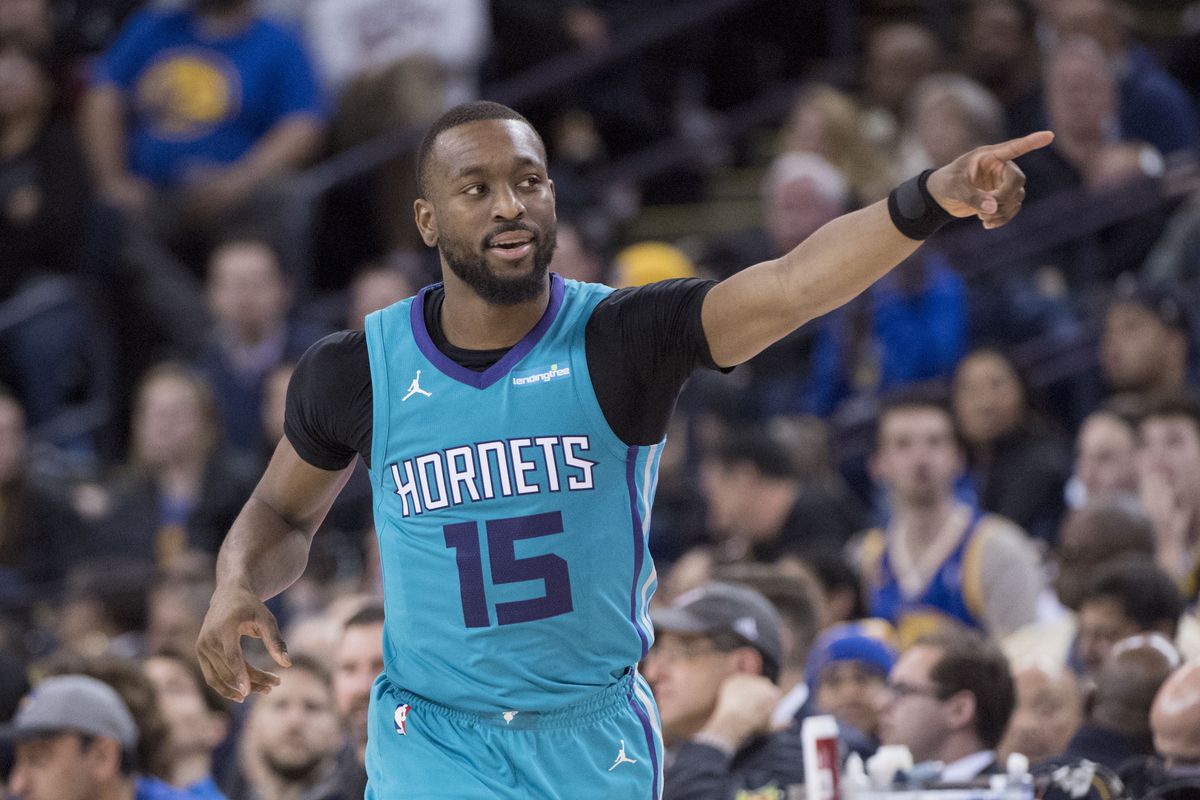
Hornets G Kemba Walker will make an All-NBA team this season, and last year's disappointing first-round pick, G Malik Monk, will have a bounce back year. The guarantee of Kemba having a monster season, and the fact that he does not have a bona-fide second banana (CJ McCollum for the Blazers) makes Kemba's likelihood of being traded this season slightly lower than Lillard's. Although, given the start to the season for both clubs, neither changing uniforms seems as likely as it did in the summer. In terms of prediction probability, Lillard seems more likely to go because of the chance that LeBron belly aches for another All-Star in Los Angeles and Lakers General Manager Magic Johnson overpays to get Lillard ASAP. Expect Kemba's strong performances night-in and night-out to lift this team to the playoffs, with aid from Monk and F Cody Zeller.
Chicago Bulls
Summary: 13th in the Eastern Conference, Lottery-Projected
Fans and media alike are apparently high on the bulls? Did we miss the news that F Lauri Markkanen is out for the 8-10 weeks with an elbow injury? There starting five through the first handful of games: G Zach Lavine, G Kris Dunn, F Justin Holiday, F Bobby Portis, and C/F Wendall Carter consists of three sub-par defenders and two young bucks who don't have their legs yet. Head Coach Fred Hoiberg does a masterful job on the offensive side of the ball, but has no chops as a defensive coach. And his roster doesn't have the chops, either. They'll struggle mightily against even averages offensive in the junior-varsity conference (Charlotte, Indiana, Orlando). Markkanen is an under-appreciated asset who could explode onto the scene in the second half of the season.
Cleveland Cavaliers
Summary: 9th in the Eastern Conference, Lottery-Projected
Kevin Love's massive deal gives the Cavaliers a star who they can rely on for offensive stability and All-Star representation in Charlotte. He won't be "Minnesota Kevin Love", a term that has been thrown out so much in the past two weeks that it has almost provided Timberwolves fans with refuge from their misery. F Cedi Osman is the closest thing the Cavs have to an up-and-coming valuable asset, since rookie G Collin Sexton won't have the exposure and experience to make an immediate impact. If the Cavs fall into the back of the Eastern Conference standings early, don't be surprised if a Kevin Love deal comes on to the table -- though this would be difficult given his current contract figure. Strange feelings of optimism for Charlotte's chances this year (I don't have an explanation for where they might be coming from) leave Cleveland on the outside looking in, ultimately.
Dallas Mavericks
Summary: 13th in the Western Conference, Lottery-Projected
As fun as an team to watch this upcoming season. The addition of rookie G/F Luka Doncic is the most Mavericks move of all time, and is almost certain to work out from an organizational and locker room culture perspective. Luka will be in the Rookie of the Year race until the very end. The Mavericks would have some sneaky playoff potential, if their ailing roster wasn't chalk full of defensive liabilities. Tune into see the G Dennis Smith Jr. Doncic backcourt take on veteran teams and make really fun plays routine!
Denver Nuggets
Summary: 4th in the Western Conference, 1st-Round of the Western Conference Playoffs
The team to watch this season -- the Milwaukee Bucks of the West, if you will. There is potential for four different individuals on this team to be in the running for the Most Improved Player(see below) and it wouldn't be a surprise if F Trey Lyles usurps some of F Paul Millsap's minutes. Even though Lyles was apart of the Donovan Mitchell trade (which Utah clearly won) his fit alongside both Millsap and C Nikola Jokic is impeccable. Jokic is going to turn even more heads this season, en route to his first (of many) All-Star appearances. The question mark for Denver is their defense, and if the young core will be able to show up in a big time first-round playoff matchup. Ultimately, this is a warm-up year for Denver, but the future is bright.
Detroit Pistons
Summary: 10th in the Eastern Conference, Lottery-Projected
The pistons will not make the playoffs this season, which is quite a statement considering they play in the Eastern Conference and they have far more star talent than the teams they'll be competing with for the final playoff spot (Charlotte, Cleveland, etc.). F Blake Griffin will put up big numbers as point forward, and the Pistons' best chance of making a push into the postseason will come from G Reggie Jackson and F Reggie Bullock's ability to efficiently score from beyond the arc. Detroit's ultimate inability to make the playoffs will come down to the poor pairing of Griffin and C Andre Drummond, limited outside shooting, and the lack of defensive talent across the Piston roster.
Golden State Warriors
Summary: 1st in the Western Conference, 2019 NBA Champions
G Steph Curry will be named the NBA's Most Valuable Player once again. The field of potential candidates is sparse; Giannis Antetokounmpo is one year away from taking over the Eastern Conference; Anthony Davis' team won't win enough games; ditto for LeBron James, and Durant, Irving, and Harden aren't popular options because of their outside perceptions. The only strong contender -- and he's a very strong one at that -- is Toronto Raptors F Kawhi Leonard. The bet is that Curry will have an audacious shooting season, even compared to his standards (50% from the field/40% from three-point range/90% from the free-throw line, 5 made three-point field goals per game, and thirty points per game). And in addition to the presence of four additional All-Stars on the Golden State roster, Curry's performances will life the Warriors to another 60-plus win season and their third straight NBA championship.

Houston Rockets
Summary: 2nd in the Western Conference, 2nd-Round of the Western Conference Playoffs
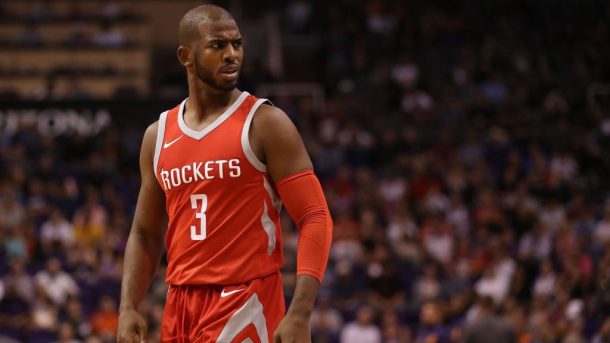
The talk this summer was all about how the Rockets got worse (which is fair) and how their title chances have already slipped away. In the realm of the National Basketball Association, this couldn't be further from the truth. Yes the Warriors are literally unbeatable certain nights when Curry, Durant and a third team member are hot. But that doesn't mean you don't assemble the 'next best thing' and compete. Injuries, roster changes, and cold streaks happen all the time (just ask the Rockets) and you never know when an opportunity to attack comes. I would not be shocked if Jimmy Butler finishes the season a rocket, and if G James Harden and G Chris Paul are health and engaged in May, the 2018-19 Rockets have a chance to compete for it all. The Rockets will appear stale and rusty during the first half of the season, but they'll still be in the race when it matters this spring.
Indiana Pacers
Summary: 5th in the Eastern Conference, 1st-Round of the Eastern Conference Playoffs
Domantis Sabonis is one of the top players to watch this season (see below), and if Sabonis can add another level of offensive versatility to this Pacer roster, they'll most certainly find themselves fighting for home-court advantage in the playoffs. G Victor Oladipo will have another All-NBA level season, but the Pacers will need help from rotation players like C Myles Turner -- fresh off his sizable extension this summer free-agent signee G Tyreke Evans. Ultimately, the Pacers are another star away from competing with the best in the Eastern Conference but they'll be congenial team to watch on both sides of the ball.
Los Angeles Clippers
Summary: 10th in the Western Conference, Lottery-Projected
If you aren't concerned with star power or highlight-making plays then the Clippers are your League Pass team this season. Head Coach Doc Rivers will make his strongest impression during his Los Angeles tenure this season. The Clippers roster features of plethora of versatile and dynamic twenty somethings who are hungry to make their mark. F Tobias Harris will get the majority of the shine, and the shots, in the regular flow of the offense. F Montrezl Harrell will continue to make covert contributions to the team that don't show up in the box score. Rookie G Shai Gilgeous-Alexander will have a lot of turnovers, and a lot of impressionable playmaking that will give Rivers and the rest of the Clipper organization hope for the future. And don't count out the possibility of the Clippers adding an All-Star before the summer, particularly Butler if his time with the Timberwolves sours further.
Los Angeles Lakers
Summary: 8th in the Western Conference, 1st-Round of the Western Conference Playoffs
F Giannis Antetokounmpo is a for-sure MVP candidate this year, but the emergence of F Khris Middleton will be the factor that determines the Bucks' success this season. And his All-Star candidacy is another fun summertime debate, because it is more so a reflection of the Eastern Conference's mediciocrity when you compare their star talent to the West (particularly with the departure of LeBron James to L.A.). Middleton has the same number of likely competitors as the Bucks do rival suitors to make the Eastern Conference Finals... three. Antetokounmpo and F Kawhi Leonard of the Toronto Raptors are locks for the starting F among the Eastern Conference All-Star group, leaving Middleton's surviving competition: 1) F Gordon Hayward of the Boston Celtics, 2) F Jayson Tatum of the Boston Celtics, and 3) F Blake Griffin of the Detroit Pistons. Middleton will beat out both Hayward and Tatum, because of injury rehabilitation and basketball adolescence, respectively. Griffin will be the greatest contender, simply because of his fan-appeal and highlight reel dunks, even though Middleton unquestionably provides more value that translates into winning on the court. Ultimately, the bet is that he, and the Bucks, will make the cut this year.
Minnesota Timberwolves
Summary: 12th in Western Conference, Lottery-Projected
There isn't much to say with this team, since we have no idea who will be on the roster by the end of the year. Ultimately, it seems the relationship between F Jimmy Butler and the organization has become irreconcilable, and it would be a complete surprise if he isn't wearing a different uniform by the New Year. Butler's departure would ensure another spring with professional basketball in Minneapolis. But before we get so down on the Wolves, remember that they have maybe the best big man of the modern era (though he didn't look the part in his first playoff action) in C Karl Anthony-Towns and a solid core built around veterans like G Jeff Teague and G Derrick Rose. G Tyus Jones is maybe the best backup point guard in the league. But that amount of talent can't get you anywhere in the Western Conference, and Minnesota will have to go back to the drawing board.
New Orleans Pelicans
Summary: 5th in the Western Conference, 2nd-Round of the Western Conference Playoffs
In the past decade of NBA basketball, there hasn't been a team with such a drastic change in expectation from one season to the next. The Pelicans dismantled the Blazers in the first-round of the playoffs last year and immediately morphed their identity to become a dynamic fluid offensive group centered around C Anthony David and G Jrue Holiday - who we can thank our lucky stars is healthy once again. The addition of F Nikola Mirotic, a no defense all offense gunslinger, has actually helped to make the Pelicans a better defensive team by forcing Davis to play at the position he best suited for, center. The Pelicans have what teams like the Timberwolves and Wizards would pay millions of dollars for, a sound locker room and great team chemistry. That alone, combined with a generational talent like Davis, can take you to the second-round of the playoffs.
New York Knicks
Summary: 14th in the Eastern Conference, Lottery-Projected
Kind of irrelevant to the 2018-19 NBA season given that they are still one of (Kings we're getting to you!), if not the most-poorly run franchises in the league and they are without their lone positive impact player for the majority of the season. However, this will be an excellent opportunity to view how Head Coach David Fizdale implements his system with young pieces who could be the core of the future. G Frank Ntilikina has the chops to be a less versatile Gary Payton, F Kevin Knox already looks like a valuable asset at the most-coveted position, and F Mitchell Robinson will be a positive-impact player very soon in his career. The stakes are high for the Knicks next summer, but the negative aura that surrounds the franchise under Owner James Dolan should make anyone skeptical of their ability to land a big fish in July.
Oklahoma City Thunder
Summary: 7th in the Western Conference, 1st-Round of the Western Conference Playoffs
Without a doubt the most-perplexing team in the NBA, since they do possess two of the top-20 players in the league and cannot seem to realize any postseason success. They were able to renounce F Carmelo Anthony from the organization prior to training camp, a major plus for a team that needs chemistry to be successful. But their bench, and Head Coach Billy Donovan's seeming uneasiness to trust anyone outside of G Russell Westbrook or F Paul George to play significant minutes leaves the Thunder significantly handicapped. The recurring injuries to G Andre Roberson will hurt this group once again. The on-again-off-again front court lineup featuring George, F Jerami Grant, and C Steven Adams should be able to dismantle small-ball wannabes in the bottom half of the league. If Westbrook can learn to limit his high-volume field goal attempt performances to only those games where he is 'feeling it', the Thunder have a decent chance of jumping into the top half of the West.
Orlando Magic
Summary: 12th in the Eastern Conference, Lottery-Projected
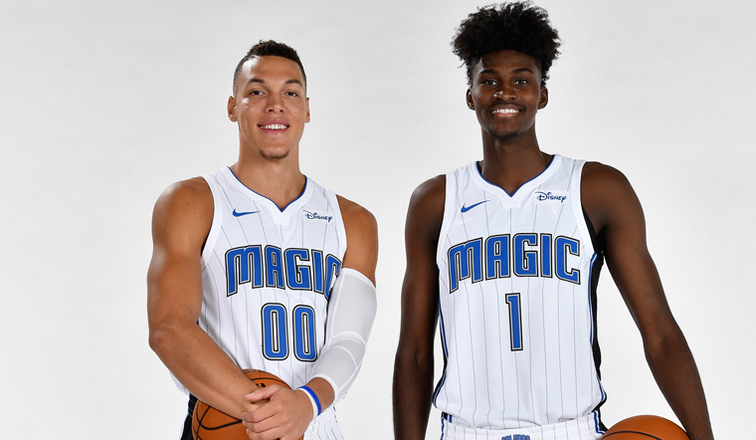
The sneakiest of the most-watchable, and simultaneously terrible, teams in the entire NBA. They have the most perplexing, yet potentially dominant, front court rotation in the entire association. Rookie C Mo Bamba will make an immediate impact on the glass and on defense, sophomore F Jonathan Isaac has the potential to be a very special player given his height and jump shot, and F Aaron Gordon will continue to put up flashy numbers without a true position to play (best at the 4, because he cannot guard on the perimeter). It will be interesting to see how the group gels, particularly under the tutelage of new Head Coach Steve Clifford. If there front office and management weren't so inept, there is a decent chance they be in the 'rising' teams section of the Eastern Conference. For now, their ceiling is somewhere near the playoff bubble.
Philadelphia 76ers
Summary: 3rd in the Eastern Conference, 2nd-Round of the Eastern Conference Playoffs
A team full of perplexing players that each deserve their own write-up. We could talk about G Markelle Fultz for hours, he still shows flashes and droughts that are common in a 19-year old point-guard. Ben Simmons has Magic Johnson level ceiling potential, if he can figure out how to co-exist and remain healthy alongside C Joel Embiid. Embiid has continued to expand his skillset outside of simply shooting and defense, and had his first full summer that didn't include injury rehabilitation. This could mean he'll have better wind and more stamina to finish games, and play longer minutes. The debate over Fultz and G J.J. Redick is a very difficult one, and it's tough to ever think of replacing the best five man lineup in all of basketball last season. This definitely seems like a vote of confidence from Head Coach Brett Brown in Fultz, and if pays off you have a dynastic core to build around. If it doesn't, you likely make the Conference Semifinals regardless. The risk-reward trade off makes sense here.
Phoenix Suns
Summary: 14th in the Western Conference, Lottery-Projected
One of two 'easy win' teams in the Western Conference (almost Sacramento, almost!) that is really too novice to mention anything in particular. Only five to seven members of the Suns active rotation will be in the league in five years, and G Devin Booker could blossom into a dynamic combo guard à la James Harden or Steph Curry if he is able to show promising court vision. The addition of Head Coach Igor Kokoškov will finally get Phoenix's long-term goal off the ground; player development and system coaching can finally begin. #1 overall draft pick C Deandre Ayton looks to be ready for the big leagues already, and is a very safe pick for the Rookie of the Year award. Maybe one day the Booker-Ayton duo will be worth discussing further.
Portland Trail Blazers
Summary: 6th in the Western Conference, 1st-Round of Western Conference Playoffs
There are a lot of things to like about this Blazer team, given the infrastructure and locker room culture that management and Head Coach Terry Stotts have developed over the past half-decade. But there really isn't a pathway for the Blazers to make it to the Conference Semifinals. Sure, injuries to opposing adversaries helps, but this roster doesn't have the offensive wherewithal and individual defensive pieces to last against an octane offense like the Warriors', Rockets', or even the Pelicans'. If Stotts is able to get this team to finish in the top-10 in defensive rating against it would be his finest masterpiece yet - the West is loaded with scoring (welcome, LeBron) and you can't have lapses in the fourth quarter on the second night of a back-to-back. The Blazers will definitely be must-watch basketball once again, but ultimately won't be able to withstand the beating coming from their conference foes.
Sacramento Kings
Summary: 15th in the Western Conference, Lottery-Projected
Finally! Oh my god! They're going to be so bad. This is a new level of bad. Definitely taking any bets on Head Coach Dave Joeger getting fired before Christmas. There is a surfeit of young players who would be incredibly fun to watch in any other system and on any other team. C Willy Cauley-Stein on the Nets? Wow, cool. G De'Aaron Fox on the Suns? They need a point guard! F Harry Giles on the Clippers? They're developing all the young guys without direction. But realistically, the system will fail this talented, yet short group once again. Expect Cauley-Stein, Fox, and F Bogdan Bogdanovic to have impressive statistical seasons and not much else.
San Antonio Spurs
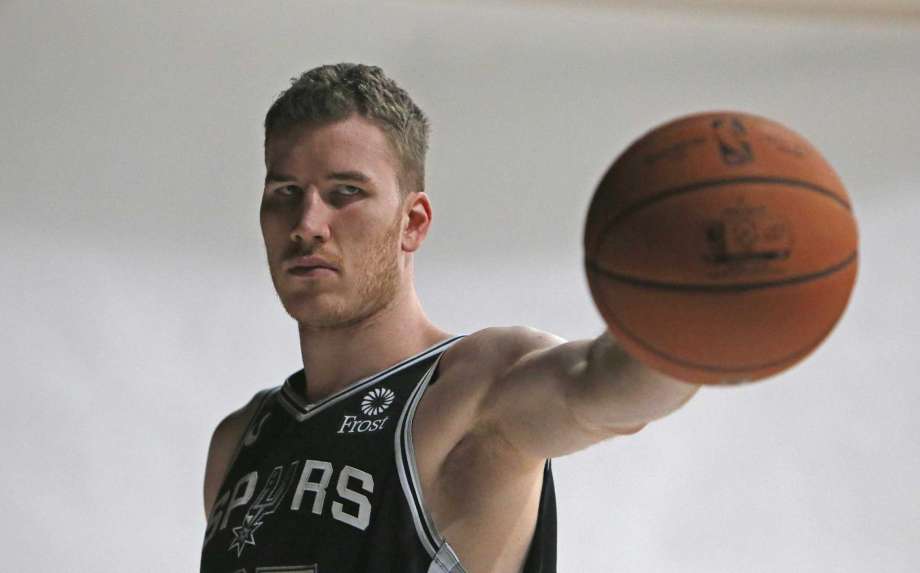
Summary: 9th in the Western Conference, Lottery-Projected
Will be an absolute joy to watch this team on both sides of the ball. Not only do we get a healthy F Kawhi Leonard, motivated and engaged once again, but we will get the opportunity to see his defensive skills combined with that of F Danny Green (traded with Leonard from San Antonio), G Kyle Lowry, F OG Anunoby, and F Serge Ibaka. The belief is that there defense will be so dynamic and versatile that it will single-handedly be enough to life the Toronto Raptors to their first ever NBA Finals. The Raptors' bench is on par with the best team's in the East, and Kawhi Leonard is a better player (when healthy) than anyone else in the conference. It will be fascinating getting to see rookie Head Coach Nick Nurse's system implemented in Toronto, given the expendable amount of talent he'll have at his disposal. Boston seems like the safe pick to represent the Eastern Conference in the Finals next June, but be wary of the Raptors' extensive bench and defensive prowess.
Utah Jazz
Summary: 3rd in the Western Conference, 2019 Western Conference Finals
Another team that could handily reach beyond their expectations if the pieces all come together. G Donovan Mitchell is a bona-fide scorer, and his game pairs incredibly well with last year's Defensive Player of the Year C Rudy Gobert. Head Coach Quin Snyder has developed a masterful system around the talent he's been bestowed; Utah has the deepest reserve of wing players outside of the Celtics. F Joe Ingles will continue to delight die-hard and casual fans alike with his outside shooting and perimeter defense. G Ricky Rubio has become somehow underrated after spending his Minnesota years in NBA fan purgatory. Ultimately, if Utah can maintain a top-5, or even top-3 level defense throughout the regular season and playoffs, they will be able to compete with Golden State and Houston. Unless Houston makes the move to acquire another piece like F Jimmy Butler, do not be surprised if the Jazz pass their way though to the Conference Finals.
Washington Wizards
Summary: 6th in the Eastern Conference, 1st-Round of Eastern Conference Playoffs
An absolute train wreck of a team that should be derailed by the league office. What G John Wall contributes in box-score statistics, he lacks in veteran leadership and commradre building. G Bradley Beal would be a joy to watch any other system than Head Coach Scott Brooks' 'my turn, your turn' offense dating back to the Oklahoma City days. F Otto Porter is a solid all-around contributor who could make a real impact no matter what role he's asked to perform in. The addition of C Dwight Howard spells problems for a locker room that's already well-versed in drama. The hope is that maybe General Manager Ernie Grunfeld will let restricted free-agent F Kelly Oubre walk to another local and join a team which will appreciate his defensive versatility. Realistically, the Wizards will make the playoffs given their top-level talent and their easy schedule, but certainly don't expect them to go any further.
Awards
Most Valuable Player
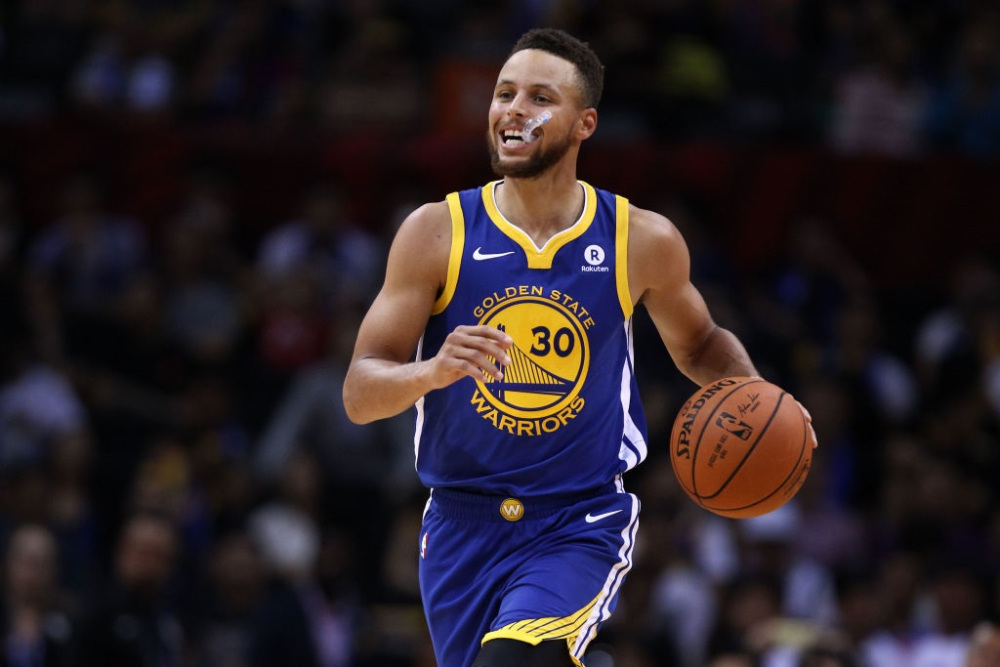
- Stephen Curry, Golden State Warriors
- Kawhi Leonard, Toronto Raptors
- Giannis Antetokounmpo, Milwaukee Bucks
- LeBron James, Los Angeles Lakers
- Anthony Davis, New Orleans Pelicans
Coach of the Year – Quin Snyder, Utah Jazz
Rookie of the Year – Deandre Ayton, Phoenix Suns
Sixth Man of the Year – Domantis Sabonis, Indiana Pacers
Most Improved Player – Jamal Murray, Denver Nuggets
Defensive Player of the Year – Rudy Gobert, Utah Jazz
First Team All-NBA
G – Stephen Curry, Golden State Warriors
G – James Harden, Houston Rockets
F – Kawhi Leonard, Toronto Raptors
F – Giannis Antetokounmpo, Milwaukee Bucks
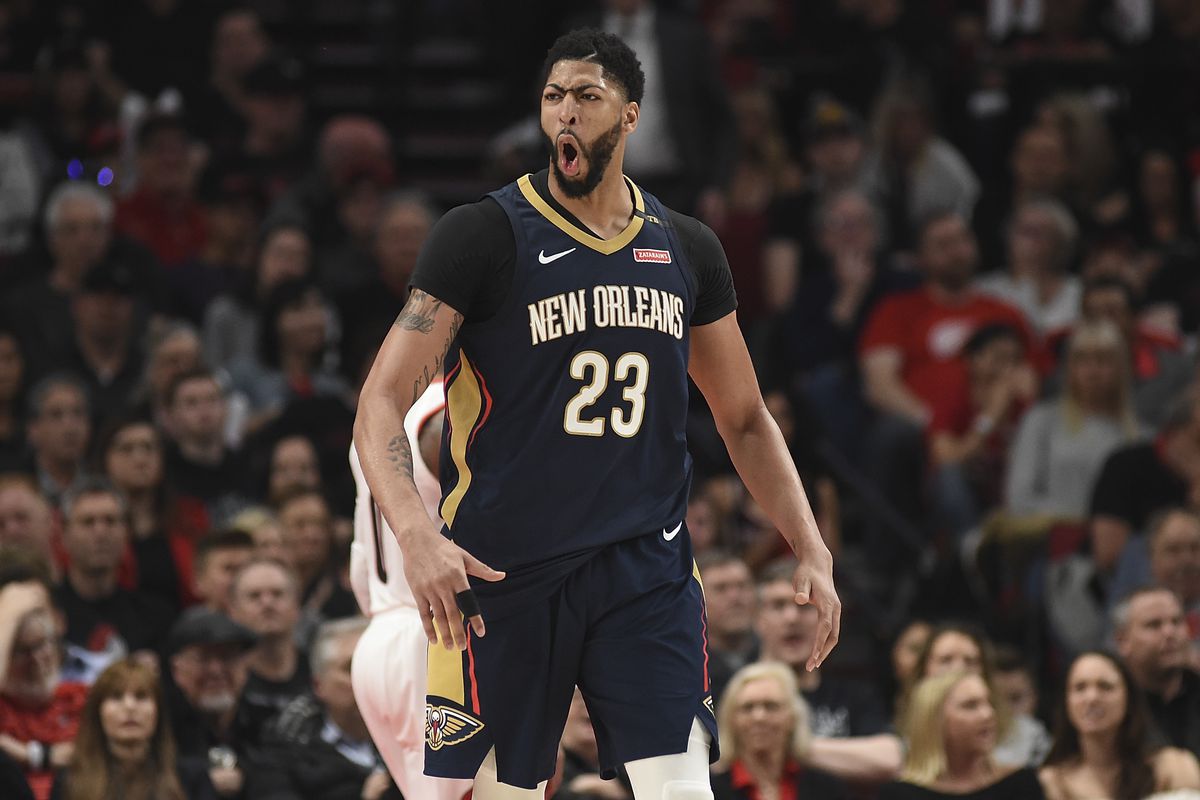
C – Anthony Davis, New Orleans Pelicans
Second Team All-NBA
G – Ben Simmons, Philadelphia 76ers
G – Damian Lillard, Portland Trail Blazers
F – LeBron James, Los Angeles Lakers
F – Kevin Durant, Golden State Warriors
C – Karl Anthony-Towns, Minnesota Timberwolves
Third Team All-NBA
G – Russell Westbrook, Oklahoma City Thunder
G – Kemba Walker, Charlotte Hornets
F – Paul George, Oklahoma City Thunder
F – Jimmy Butler, TBD
C – Nikola Jokic, Denver Nuggets
Five Players to Watch
Non-All-Stars
- Khris Middleton, Milwaukee Bucks
- Gary Harris, Denver Nuggets
- Jerami Grant, Oklahoma City Thunder
- Josh Richardson, Miami Heat
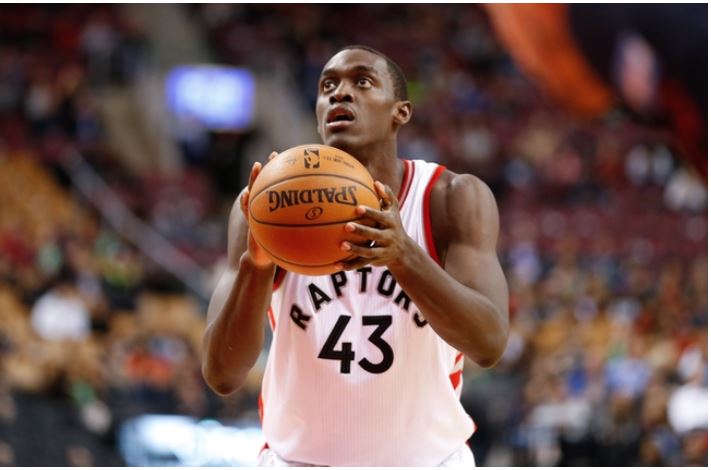
- Pascal Siakim, Toronto Raptors
Five Young Guys with Potential
Non-Rookies
- Lonzo Ball, Los Angeles Lakers
- OG Anunoby, Toronto Raptors
- Jakob Poeltl, San Antonio Spurs
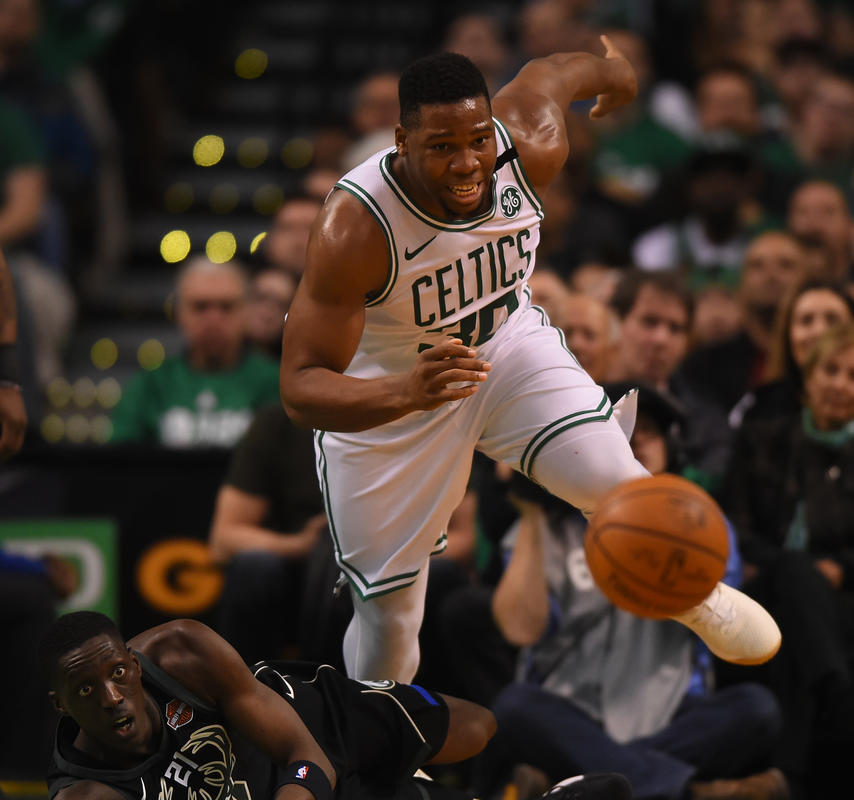
- Guerschon Yabusele, Boston Celtics
- Skal Labissiere, Sacramento Kings (repeat offender)
Five 'Fire Hoses'
Shoot-Only Talents
- Nik Stauskas, Portland TrailBlazers
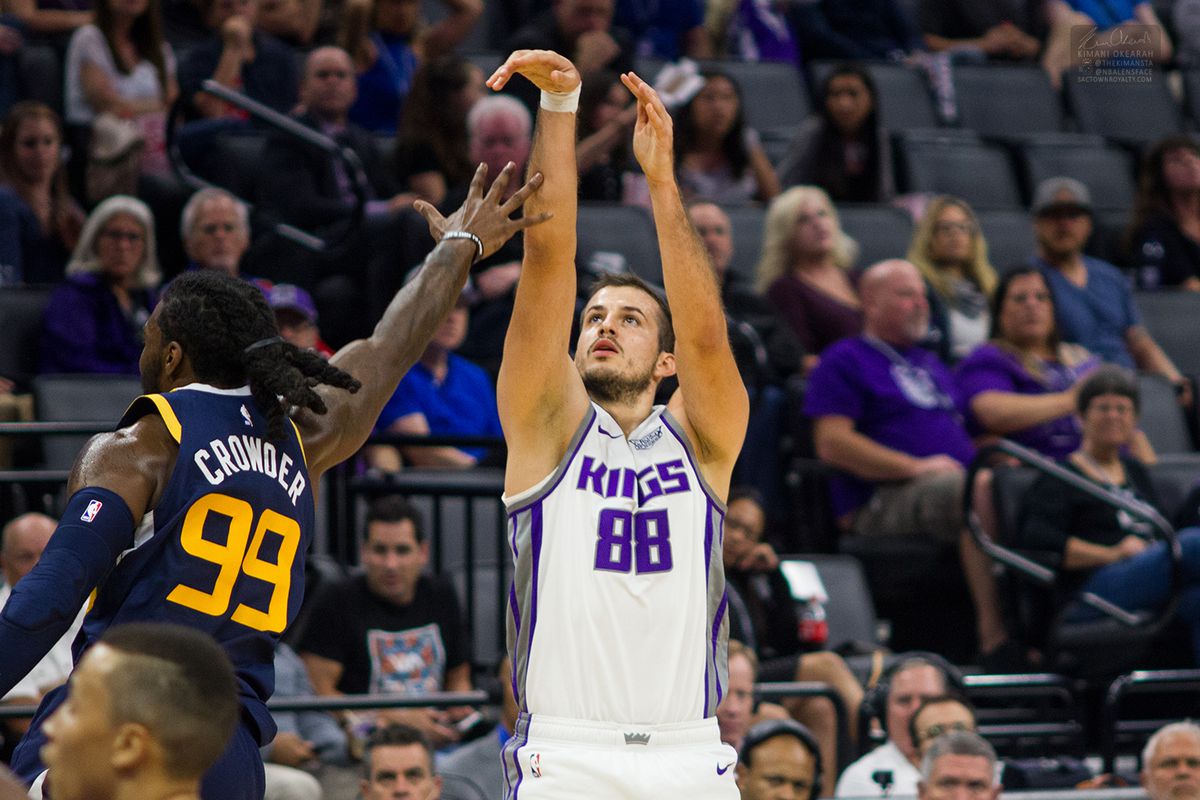
- Nemanja Bjelica, Sacramento Kings
- Joe Harris, Brooklyn Nets
- Wayne Selden, Memphis Grizzlies
- Rodney McGruder, Miami Heat
POSTSEASON
Western Conference
First Round:
- GSW vs. 8. LAL
- HOU vs 7. OKC
- UTAH vs 6. POR
- DEN vs 5. NOP
Second Round:
- GSW vs 5. NOP
- HOU vs 3. UTAH
Western Conference Finals:
- GSW vs 3. UTAH
Eastern Conference
First Round:
- TOR vs 8. CHA
- BOS vs 7. MIA
- PHI vs 6. WAS
- MIL vs 5. IND
Second Round:
- TOR vs 4. MIL
- BOS vs 3. PHI
Eastern Conference Finals:
- TOR vs 2. BOS
2019 NBA Finals
Golden State Warriors vs Toronto Raptors
2019 NBA Champions
Golden State Warriors
Salary Cap 101 & the 2018-19 okc Thunder
The fundamentals of the NBA salary cap, and why this year's Thunder team is an aberration
--------------
Since we have officially exited summer, it only seems fair to reflect on what we learned and re-hash the single most uttered word of the previous three months: cap. Cap can mean a lot of things in the English language, and can be used as both a noun and verb. But in the language of professional basketball, "the cap" means one very specific thing. A single artifact created by the league office that team executives and fans think about on an almost 12-month basis in today's NBA. The NBA's salary cap, or "cap" as it is commonly referred to, is the league-wide standardized figure that limits how much teams can pay for their combined 15-player roster salary. Proper management of the cap can be the difference between a successful franchise and an inept one.
The NBA structures their salary cap slightly different than other leagues. Instead of using a "hard" cap, or a restricted limit on player payments beyond the set cap "ceiling", similar to that currently employed by the National Hockey League, or the absence of a cap at all, allowing limitless spending by franchises as is done in Major League Baseball, the NBA employs a totally unique system referred to as the "soft" cap. This system, which utilizes what is called a luxury tax, lets teams exceed the cap only if they are willing to pay a tax bill for each dollar above the given cap figure for that season (and at exponential percentages as you move further and further beyond certain thresholds). So for example if the salary cap is set at $102 million, like it is for the NBA's 2018-19 season, and the Golden State Warriors want to pay their players $144,000,000, as they are prepared to do so this season, then they would incur a luxury tax bill for those $42 million dollars which are above the cap line.
This may seem self-evident, but cap management is essential for success in the NBA. While few markets actually attract the very best free agents each summer, the use of smart cap management can put teams in place to attract top talent, and translate this talent introduction into wins on the court. A great example comes from Ian Thomsen's latest work The Soul of Basketball, which gives an inside perspective of how Miami Heat General Manager Pat Riley planned for the summer of 2010 and the free agency of All-Star F LeBron James. Riley knew that both James, the homegrown Cleveland Cavalier, and F Chris Bosh of the Toronto Raptors would be unrestricted free agents in the summer of 2010, meaning they were free to decide whichever team they would like to sign their next contract with. In what would be considered commonplace today, Riley ingeniously revolutionized cap management by intentionally signing one- and two-year deals for the Miami Heat's roster during the 2008 and 2009 seasons so he would have enough room to pair James and Bosh with his own homegrown All-Star G Dwyane Wade in 2010. And the rest is history; the Heat went from winning 15 games in 2007-08 to hoisting the Larry O'Brien championship trophy in back-to-back seasons in 2012 and 2013.
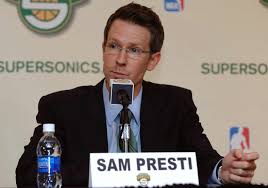
Oklahoma City General Manager Sam Presti has employed similar management techniques in the Thunder front office, and it remains to be seen whether he will finally capture the illustrious accomplishment which now defines Riley's executive career - an NBA championship. Presti is widely-recognized for how he has turned around the franchise since he took over as General Manger of the Seattle SuperSonics in 2007. Over the past decade, he has been responsible for drafting Kevin Durant, Russell Westbrook, and James Harden - all of whom have won the NBA's Most Valuable Player Award. Presti focused on signing frugal veteran contracts, and made a contentious trade for C Kendrick Perkins, to assemble a young and versatile core in Oklahoma City that reached the NBA Finals in 2012, ironically losing to Riley's Heat. But since the departure of James in 2012 and Durant in 2016, Presti has had to face a harsh reality: Oklahoma City is not a free-agent destination and Russell Westbrook is not content with spending his prime years waiting for a franchise rebuild. As a result, Oklahoma City's ownership group and Presti have committed exorbitant dollar figures to keep their team in the playoff and championship race.
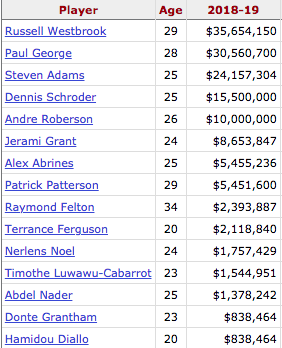
There are teams, namely the Golden State Warriors, who face payroll figures akin to the Thunders'. But the 2018-19 Thunder roster is an aberration because no small market team has ever incurred this kind of financial responsibility in a single season. The Thunder's strategy isn't inherently flawed - they've positioned themselves to compete for the foreseeable future and were able to exorcise the spirit (almost literally in terms of basketball contribution on the floor) of 34 year-old Carmelo Anthony and his $25 million contract for the 2018-19 season. But like all successes and failures, timing plays an integral role in the outcome of an NBA season, and as it is widely-known this is the League of Golden State until any occurrence gives us pause to believe otherwise. And currently, it seems, Oklahoma City's championship window coincides perfectly with the Warriors'; Curry and Durant are 30 and Westbrook and George are 29 and 28, respectively. Ironically, Oklahoma City's one slim chance to revel in championship glory comes from the cap, and Golden State's ability to manage it as well. Durant will be an unrestricted free-agent this summer along with All-Star G Klay Thompson, and Warriors General Manager Bob Meyers will have his own financial commitment to make to half of his current foursome of All-NBA talent.
In the NBA, it always come back to the cap, and how well a team is able to manage it. It is true in both the gym and in the front office: championships are won in the summer, not in the spring....
Dream School'S Next Pupil
How the Greek Freak Could Take His Game to the Next Level
--------------
The NBA offseason is typically a time to reflect; ponder the previous season and project what it will tell us about the upcoming one. Players spend their time doing personal workouts, posting on Instagram, and traveling on behalf of sponsors to promote their personal and corporate brands.
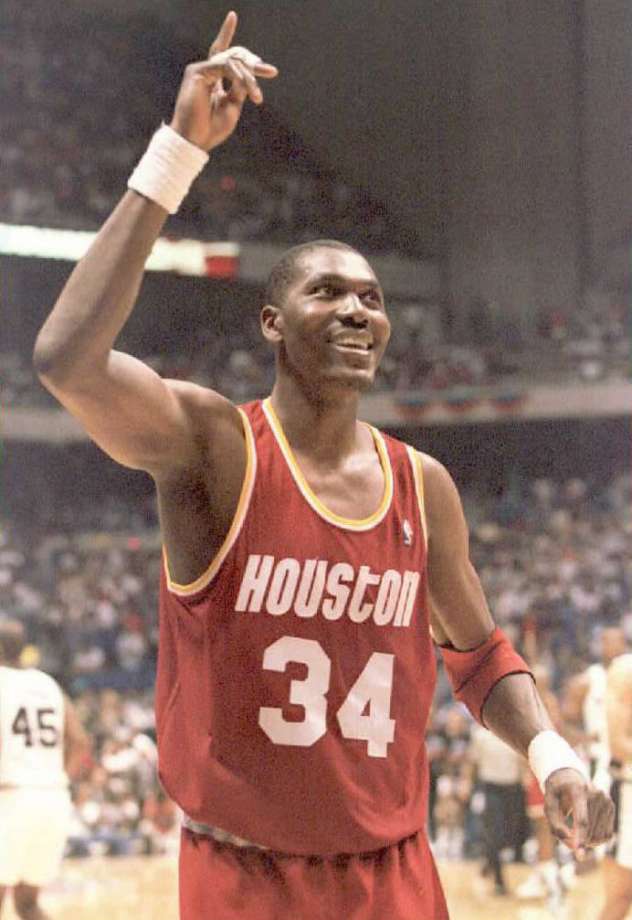
And if you're among an elite selected group of the most-heralded NBA stars you will also spend limited parts of your offseason in Houston, Texas. Yes, Houston. Not Southern California, or Manhattan, or the south of France, but Texas. The only reason being that Houston is the home of the most-heralded master of the post move; a savant of the 'back-to-the-basket' game, and the creator of the "Dream Shake". The most distinguished basketball footwork virtuoso in the entire world: Houston Rockets Hall of Fame C Hakeem Olajuwon. For those who aren't familiar with Olajuwon, here's a quick lesson: he is one of four players to score a "quadruple-double" (10 or more in four categories - traditionally points, rebounds, assists, and blocks/steals - in a single game), he is the 1994 NBA MVP & Finals MVP, and considered the greatest international NBA player of all-time.
How To watch: 2018 conference finals
The 3 players & 3 metrics to study in the NBA semifinals series
--------------
Eastern Conference Finals: Cleveland Cavaliers vs. Boston Celtics
The 3 Players to Watch
1. LeBron James
No surprises here - the greatest player on the planet, playing the best ball of his playoff career. LeBron notoriously does well in the Garden - averaging 29/8/8 throughout his career against the Celtics. He had the greatest playoff performance of this generation, if not all-time, in TD Garden 6 years ago. LeBron James will dictate as much as anyone how quickly this series will be over - if James is as efficient offensively and committed defensively as he was against the Pacers and Raptors in the first two rounds, this series will be over rather quickly. But the Celtics are different than the Pacers and Raptors, and LeBron knows this. They have a better defensive system, less ball-dominant players than both previous opponents, and one of the greatest basketball minds game-planning for how to slow down #23. LeBron knows that he will have to get teammates (particularly F Kevin Love - see below) and marginal role players F Tristan Thompson and G JR Smith to contribute offensively. LeBron has mastered feats much more daring than this, and the assumption is he'll have another all-time Conference Finals performance.
2. Kevin Love
Love has been miscast many times in his career, and much of his time in Cleveland has been defined by outside "disappointment" from fans and media on his inability to replicate his work in Minneapolis in a Cavalier uniform. Love has been less than stellar - particularly in the postseason - during his time in Cleveland. This is undeniable. But the fault is not Love's alone - it's James who also has to take some responsibility for Love's inconsistencies in the biggest moments. If Love and James are able to find their ideal Stockton-and-Malone two-man game in this series, that will neutralize Boston's half-court defensive strategies and then the Celtics will have to overload - opening up opportunities for Smith, G Kyle Korver, and G George Hill. But Love also has to come out with a ferocity and decisiveness that he will control the game on the glass and purposefully play with an aggressiveness on the offensive end. If Love is able to find his rhythm early in the series in Boston, taking control in Cleveland will be relatively easy for the Cavaliers.
3. Jaylen Brown
Brown's development in the first two-rounds of this postseason, and in the first two seasons of his career, have been tremendous. He will be given the toughest assignment in basketball - guard LeBron James in a seven-game series with the season on the line. While Brown is as versatile as just about any player in the league - he's covertly one of the stronger players in the Eastern Conference and has a tremendous amount of length to contest turn-around shots in the midpost (a staple of LeBron's diet in May) - he'll need to elevate his game to All-Defensive levels if the Celtics want to extend the series to Memorial Day Weekend. Brown will need to provide a necessary aggressiveness on the offensive end as well - looking to create for teammates and pressuring Cleveland's less-than-stellar help defense.
The 3 Metrics to Follow
1. Three Point Efficiency
Cleveland becomes a juggernaut offensively (and subsequently don't have to try to defend in transition) when they are making their three-point attempts. Boston similarly finds a new offensive level (one that they desperately lacked once G Kyrie Irving's season ended prematurely) when they are efficient from beyond the arc. The ability of role players to knock down open and semi-open attempts from the 3-point range will certainly swing at least one or two games in this series. The Celtics can use these kinds of makes - specifically from Boston crowd favorites G Terry Rozier and F Jayson Tatum - to fire up their crowd and gain confidence early in the series, which will be crucial when they go back to Cleveland for Games 3 and 4.
2. Turnovers
Boston does a tremendous job of being efficient with the basketball on offense; their biggest problem comes in the portion of the possession where you have to get the ball through the hoop. Cleveland, on the other hand, has games where they are incredibly careless with the ball. Role players like Hill, Smith, F Rodney Hood, and G Jordan Clarkson - whom are all particularly turnover prone - will have to limit turnovers that spark easy Celtic points. If the Cavaliers average 16 or more turnovers in the series, the Celtics could being representing the Eastern Conference in the 2018 NBA Finals.
3. Rebound Differential
Rebounding is as important to Cleveland's success as LeBron James' playmaking - it creates easy opportunities on kick-outs and tip-ins that provide Cleveland with rhythm (and LeBron James a much-needed break). Specifically Love and Tristan for the Cavaliers on the offensive end, and Horford and C Aron Baynes for the Celtics on the defensive end, will decide how the rebound battle is won on each side. Love and Thompson will each have a 15 rebound game at some point in the series, the Celtics will need to assure that this is a one-off occurrence rather than a commonality if they want to extend the series past four games.
Prediction: Cleveland 4-1
2018 Western Conference Finals: Golden State Warriors vs Houston Rockets
The 3 Players to Watch
1. Draymond Green
Even though the Warriors and Rockets are two of the best teams on both sides of the ball - there are very few players in this series who have the ability to make an individual impact offensively and defensively. Draymond is coming off one of the best playoff series of his career - averageing 15/10/10 along with 1.6 blocks per game while guarding the best big man in the game. He started knocking down outside shots (a strong indicator when Green is engaged and playing at his ceiling), going 8/20 from beyond the arc, and increased his total field goal attempts from their first-round series against San Antonio. Draymond has the ability to be the most impactful player in the series if he is able to continue knocking down three-point attempts (Rockets Head Coach Mike D'Antoni will invite Green to shoot often and early) and drag Rockets C Clint Capela out of the paint to open up driving lanes for teammates (where Golden State seeks to shoot the majority of their shots).The Warriors are at their best when Green is grabbing defensive rebounds and pushing the pace for easy baskets - and his ability to control tempo will be a deciding factor in the series.
2. James Harden
In a month and a half James Harden will be crowned the league's MVP. For Harden to be a truly deserving MVP, we need to not look back at this series with the same disdain as the Rocket's Conference Semifinals loss to the San Antonio Spurs in 2017. Harden has to be an offensive juggernaut - seeking out mismatches, creating high-percentage looks for teammates who can't create their own, and getting to the free-throw line at his regular season rate. The expectation is that Harden will be great - he doesn't have to shoulder a tremendous offensive burden this time with the addition of G Chris Paul, and his game has matured as his role has evolved in Houston. Like Green, Harden has the ability to control the game with the ball in his hands, and he must be willing to trust his teammates as the Warriors help-over or double on his dribble drives to the rim.
3. Luc Mbah A Moute / PJ Tucker
Mbah A Moute and Tucker have to knock down 34% of their open 3-point attempts and consistently contest Kevin Durant when he creates off the dribble for Houston to have a fighting chance.
The 3 Metrics to Follow
1. Pace Factor
Pace is an estimate of the number of possessions a team uses in a game. The Golden State Warriors are the fastest remaining team in the playoffs, while Houston is one of the slowest. The team which is able to dictate the pace they are more comfortable playing at (Warriors prefer it fast, Houston prefers it slow) will have a tremendous advantage in this series. Watch for Pace to be an especially large factor in Game 1 Monday night, as each side begins to feel out their respective advantages in the matchup.
2. Free-Throw Attempts
As mentioned above, the Houston Rockets - and more specifically James Harden - get to the line at a tremendously high-rate given their offensive tempo and desire to attack out of isolation. This shouldn't be a surprise since scoring from the free-throw line is a staple of any analytics-based offense, especially MoreyBall. The Rockets' free-throw attempts and free-throw differential will be a key indicator of how Golden State's defense is operating. Golden State becomes almost unbeatable when their defense is at it's highest level and they are eliminating their opponents' easy opportunities (specifically at the rim, from the free-throw line, and outside the three-point line).
3. Points in Transition
The ultimate indicator of who is dictating Pace Factor (above) and using their defense to create offense. If the Warriors are able to get open looks in transition, this series is all but over from the tip. D'Antoni and Houston will smartly slowdown the game and try to limit turnovers in order to keep the Warriors from getting out on the break and creating energy on long transition 3s, particularly in the first and third quarters when the Warriors' best lineups are in. It will be an added bonus for the Rockets if they are able to create their own easy looks in transition.
Prediction: Golden State 4-1
The inaugural playoff preview
What to watch for in the first round and beyond
--------------
Damian Lillard as an MVP Candidate
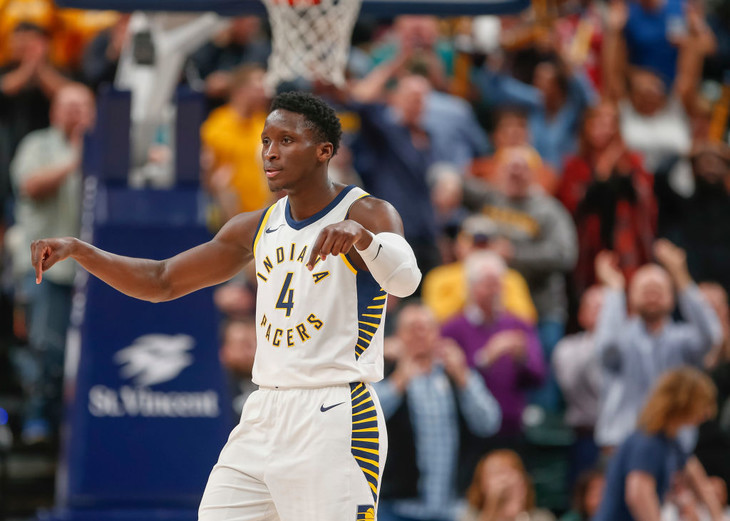
Throughout the Portland Trail Blazers’ campaign to the three seed in the West, few have systematically followed how the team achieved their success. While the ‘East Coast bias’ is still strong in the NBA, any basketball junkie knows that you cannot deny Portland’s legitimacy this season. And -- as Zach Lowe beautifully documented for ESPN -- Damian Lillard is the reason for a great majority of the Blazers’ success.
We can first give credit to some of the other pieces which propelled Portland to the seventh best record in the Association – Mo Harkless and his improved outside shooting; Al Farouq-Aminu and his improved defensive malleability; Shabazz Napier’s emergence as a viable offensive weapon in his third year; and Zach Collin’s eventual break-out as one of the most coveted assets from the class of 2017. But Lillard’s uncanny ability to carry the team during stretches of the season proves his legitimacy; and with CJ McCollum having a slightly less fruitful season than his previous two, the Blazers’ regular season success looks that much more impressive.
Lillard’s prowess has come from learning how to attack weaker defenders in the pick-and-roll, subjugating middle-tier wing defenders and slow-footed big guys to one-on-one matchups where they stand a slim chance of coming out successful. The Blazers want Lillard to dictate the pace and shot selection for the rest of the team because only McCollum and Napier (when he's really having a strong night) can create their own shots in a pinch. Lillard also hasn't been as bad defensively as in years past, a small contribution that strongly contributed to the Blazers' jump from 24th overall defense last season to 7th this season. There is no guarantee that the Blazers will be able to dominate at the same level in April, and possibly even May; but what is certain is that Lillard has been one of the most valuable players in the league this year.
Josh Richardson & the Heat as Conference Contenders
The bottom half of the Eastern conference side of the playoff bracket has been publicized over the last week as being “open for the taking” -- given the injury problems of the Boston Celtics, the Milwaukee Bucks’ unexplainable struggles on the defensive end of the court, and the Philadelphia 76ers’ inexperience. This is not a prediction that Miami will make the Eastern Conference Finals (and far from, as you’ll see below) but rather a legitimization of a team that has been under-appreciated for much of the regular season.
Quickly, this is a recognition of the progress and development G Josh Richardson has made over the past season and half -- becoming a 40% shooter from outside and a candidate for one of four guards spots on the NBA's All-Defensive Team. His defensive instincts have been a perfect marriage for Head Coach Eric Spoelstra's system -- which focuses around providing pressure and secondary help when opponents penetrate to the paint. Look at Richardson jump off his man mid-penetration and contest without fouling as he is half-step behind Hawks G Damion Lee. The instincts, the ability to contain penetration without fouling, and the last-second athleticism to contest Lee's shot show how valuable Richardson has been for this Miami Heat defense this season.
Can Miami push Philadelphia? Absolutely. Their defensive structure and variety of options on the wing gives them the tools necessary to contend with anyone in the East. There is a path for them to make it to the Eastern Conference Finals and matchup with the less-than-stellar Cleveland Cavaliers for a chance to play in June. Richardson will be a key contributor if Miami has any chance of realizing this goal, and they will need contributions from a multitude of players on both ends of the court. If I were in the East, I would be weary of Richardson and the Heat.
First Round Preview
Houston (1) vs Minnesota (8)
It’s difficult to see how Minnesota will matchup with Houston’s arsenal of shooters. Since Minnesota has failed to be even a league-average defense this season -- particularly in stretches where they have missed star F Jimmy Butler -- the likelihood of the Wolves getting a game, let alone winning the series, is quite slim.
If Minnesota has a chance of hanging in games when Houston is firing on all cylinders, they will need to go to lineups featuring G Tyus Jones rather than G Jamal Crawford or F Gorgui Dieng. Jones has been one of the league’s best on-ball defenders according to the Defensive Real Plus-Minus (DRPM) metric, and Minnesota needs all of it’s defensive prowess engaged for 48 minutes to keep it close. Regardless of the Wolves’ engagement, G James Harden and G Chris Paul will be able to easily control the tempo of the game given Minnesota’s struggles in transition.
The matchup to watch in this series is C Karl Anthony-Towns for the Wolves going against C Clint Capela of the Rockets – two young dynamic bigs who impact the game is vastly different ways. Towns will be looking to make his case as the best center in the NBA in his first trip to the playoffs (and Minnesota’s first in 14 seasons!!). Ultimately, Harden and the Rockets will be too much to handle for these young Wolves.
Prediction: Houston 4-0
Golden State (2) vs San Antonio (7)
Probably the least interesting matchup in the first round given G Stephen Curry’s sidelining with a Grade 1 MCL sprain. And yes, F Kevin Durant and G Klay Thompson still play for the Warriors. Most of the disinterest comes from their opponent, the San Antonio Spurs. The Spurs have been a strange anomaly this season, and another wonder story to add to Head Coach Gregg Popovich’s resume of improbable success. The players that will play significant minutes in this series are: G Dejounte Murray, G Patty Mills, G/F Danny Green, F Davis Bertans, G Brent Forbes, F Lamarcus Aldridge, C Pau Gasol, F Rudy Gay, F Kyle Anderson; and maybe (maybe) if we’re lucky we’ll get some F Joffrey Lauvergne. One of these players will make an All-NBA team -- hell only one will even be considered for the honor.
This is not to say that San Antonio won’t make it competitive. The Warriors without Steph Curry have sputtered over the past month of the season, and there have been numerous dialogues published about how Curry is the MVP of this Warriors team (ESPN Kevin Pelton’s being the nonpareil) and how his presence changes their rhythm -- their swagger. Without Curry, San Antonio has the potential to make it a longer series than expected, but with a healthy Klay Thompson and Kevin Durant the Warriors have too much fire power for the Spurs to survive.
Prediction: Golden State 4-1
Portland (3) vs New Orleans (6)
This is by far the most difficult series to predict in either conference. Didn’t everyone unanimously agree the Pelicans were done when C Demarcus Cousins was declared out for the season in January. Didn’t we all unanimously agree Portland would be on the playoff bubble in this loaded West Conference? Basketball is fun.
To point to two constants in a series filled with numerous variables -- Mo Harkless’ health being number one -- each team has a top-5 MVP candidate on their roster. Damian Lillard (documented above) will be the offensive engine keeping Portland alive. C Anthony Davis of the Pelicans plays a similar role as New Orleans’ engine on both defense and offense. The key for this series will be Portland’s ability to contain the phenome from getting 30 points and 20 rebounds a night.
Blazers Head Coach Terry Stotts will likely throw a variety of defensive schemes anchored around C Ed Davis and F Al Farouq-Aminu to contain Davis (C Jusuf Nurkic will try and likely fail to contain Davis at the start of the 1Q and 3Q). Ditto for Pelicans Head Coach Alvin Gentry and NBA All-Defense candidate G Jrue Holiday for containing Portland’s dynamic backcourt. Ultimately this series may come down to the “other guys”: C Zach Collins, G Shabazz Napier, G Pat Connaughton, F Solomon Hill, G Darius Miller, G Rajon Rondo (remember playoff Rondo?!), and F Nikola Mirotic. Given these circumstances, the series has the potential to go seven or end in five either way.
I’ll hang my hat on Damian Lillard and Coach Stotts.
Prediction: Portland 4-2
Oklahoma City (4) vs Utah (5)
By far the most intriguing first round matchup -- a juxtaposition of two very distinct styles: one team chalk-full of name brand superstars, the other staffed with under-the-radar utility players who make a significant unsung impact night after night. The greatest example of this is at the starting F spot: Carmelo Anthony of the Oklahoma City Thunder matched up against Joe Ingles of the Utah Jazz. Most casual NBA fans would assume Carmelo to be the far superior player (his $20 million contract figure supposedly would back this up), but this season it isn’t even close. Ingles has been the far superior player in every single dimension of the NBA game (somehow even in offensive efficiency!).
This series will either come down to Oklahoma City’s ability to control the glass and get out in transition (if you’re watching on television look at the rebound differential and points in transition numbers) or Utah’s three-point efficiency (on television -- three pointers made differential). The most likely contributor on either side for these numbers would be C Steven Adams (rebounding) and F Jae Crowder (three-point shooting).
If G Andre Roberson were healthy for the Thunder I would give them a significant chance of winning this series -- simply because of the impact he has for this team on the defensive end. Utah’s defensive abilities need no explanation - they are essentially the league’s best team defense with the league’s best defensive player this season. If the games reach the triple-digits consistently, Oklahoma City has a much greater chance of finishing this series than if they stay in the nineties or even upper-eighties.
This is by far the most important series for Oklahoma City in terms of long-term franchise impact (even greater than the 2016 Western Conference Finals, which lost them F Kevin Durant). A first-round loss would essentially ensure F Paul George’s departure and likely F Carmelo Anthony would follow (not necessarily a bad thing). Then your options become limited with the most expensive player in league history on your roster and the worst secondary unit among all playoff teams this season. The Thunder (and G Russell Westbrook) know how badly they need this series, and they’ll get it. Utah (and rookie G Donovan Mitchell) are ahead of their projected timeline after losing All-Star F Gordon Hayward last season. For this reason, I’ll give the edge to Oklahoma City.
Prediction: Oklahoma City 4-3
(Sorry to all Carmelo Anthony fans.)
Toronto (1) vs Washington (8)
This series -- like almost every other Raptors series in the past five seasons -- will be dictated by which Toronto team shows up. If G Demar Derozan, G Kyle Lowry and the stellar bench production from the regular season is a constant throughout much of the first two games in Toronto, then the Raptors will win this series in five or six games. However, if they come out slow and continue their streak of first game losses in playoff series, there is a potential for the Wizards to make this a series.
The biggest unknown coming in will be F Otto Porter’s health. As the Wizards’ third-best option on offense, his lost production will hurt Washington’s offensive production tremendously -- given that he is the second best outside scoring threat behind G Bradley Beal. Washington can certainly survive without him -- F Kelly Oubre has been a quasi-starter for this team for almost fourteen months now, and provides solid minutes on both sides of the court whenever he gets an opportunity in prolonged stretches. G Tomáš Satoranský will also need to contribute an efficient scoring punch off the bench to keep the Wizards afloat, particularly during road games in Canada.
It’s hard to imagine going this long in a Wizards playoff game preview without mentioning their perineal All-Star G John Wall. But that essentially sums up Washington’s season. We don’t know which John Wall we are going to get, and neither does Head Coach Scott Brooks. If Wall plays at the level many know he’s capable of in the playoffs, and the Raptors come out flat in Saturday’s contest, look for Washington to stretch the series to six or seven games. The bet here is that Toronto will struggle, but hang on.
Prediction: Toronto 4-2
Cleveland (4) vs Indiana (5)
Another LeBron James playoff spring, and another set of “worries” for the Cleveland Cavaliers. Yet for all the troubles the Cavaliers have suffered this year, they still have the most valuable asset any team can have in a playoff series -- the guaranteed best player on the floor. Give Indiana and Head Coach Nate McMillan credit, their franchise star (F Paul George) was traded in the summer of 2017 and many within the league assumed the Pacers to be a league-wide doormat for the foreseeable future.
But Indiana’s two return trade assets -- G Victor Oladipo and F/C Domantis Sabonis -- continued to expand their games and embraced the increased offensive and defensive responsibility in their new roles, respectively. Oladipo will certainly be the league’s Most Improved Player this spring, after transforming his offensive game drastically to improve his efficiency while using his defensive stability as a spring board into the All-Star and All-NBA conversation. Indiana more well-known contributors -- F Thaddeus Young and C Myles Turner -- had less than desirable seasons from a productivity stand point. But McMillan and G Darren Collison provided a leadership glue to hold all of these seemingly mismatched puzzle pieces together.
The split in this series will come down to Cleveland’s bench and rotational players not named F Kevin Love. F Rodney Hood coming back from injury should give the Cavaliers another outside threat to space the floor and let James be the all time great floor general he is. G Jordan Clarkson will have to have a hot night in at least two of the first four games (quite likely he’ll do both at home in games 1 and 2) to give the Cavaliers a shot of adrenaline. F Tristan Thompson will have to show some shadow of his former self on the defensive glass to give the Cavaliers transition opportunities. While there is potential for Cleveland to stumble out of the gates, the more likely outcome (proven by history) is that LeBron James takes over the series and wills his team to victory.
Prediction: Cavaliers 4-1
Boston (2) vs Milwaukee (7)
A myriad of injuries and mismatched players who will have significant roles -- who has any idea how this series will play out? Let’s first examine the constants we know to be true (in alternating order). First, Celtics Head Coach Brad Stevens has arguably been the best coach in the NBA this season. Second, Bucks F Giannis Antetokounmpo will be head-and-shoulders the best player on the court, and should be able to dictate pace and action with his length and skill. Third, Celtics F Jayson Tatum is a rookie who has never played in a playoff game. Fourth, the Bucks’ defense has consistently underachieved the entire season finishing just eighteenth among all thirty teams.
Did this help to clear up the outcome or make it even more uncertain? The only clear advantage in the series comes from the coaching seat, and as a result I’ll give a slight edge to Boston.
Prediction: Celtics 4-3
Philadelphia (3) vs Miami (6)
As previewed slightly above, this series seems to be a fun house mirror of a matchup -- deceiving NBA fans into thinking that one team is the obvious choice. This is entirely dependent on the Philadelphia 76ers and their ability to control the game without All-Star C Joel Embiid. Rookie G Ben Simmons will have to be the best player on the floor -- both defensively and offensively -- if the 76ers are going to expose the Heat in a way that many are predicting.
Miami is a well-coached and dynamic roster with multiple options that both have playoff experience and the ability to contribute pointedly in crucial areas on the court. All-Star G Goran Dragic’s speed and aggression will give Miami the opportunity to test Philadelphia’s transition defense. F Kelly Olynyk rebounding and offensive spark plug off the bench gives Miami a very real offensive threat to turn to in crucial moments. F James Johnson’s sporadic ability to be a floor general and semi-knock down shooter provides Miami with much needed outside shooting. Ditto for NBA journeyman G Wayne Ellington. This Miami team will not lay down.
The most interesting facet of this series will be seeing how Simmons, G Robert Covington, F Dario Saric, and rookie G Markelle Fultz play in their first playoff action. All have the ability to impress and make a high level impact immediately -- all are coveted members of the esteemed Process folklore quintet (including Embiid). Now we have to see if they perform when the lights are brightest -- and for this reason, this will be the most fascinating first round series in the East.
Prediction: Philadelphia 4-2
Why the Warriors Are Still the Favorites
It is quite surprising how much the narrative in the NBA has changed in nine months. Even as early as last September, it would be hard to find a single media member or impartial fan that would pick any team other than the Golden State Warriors as their 2018 NBA Champions. As recently as last week, the Houston Rockets have become the title favorites among both the statistical model predictions (represented here by fivethirtyeight.com) and the sports books in Las Vegas (represented here by Bovada).
First off, this is not a diatribe against the Rockets. What they have accomplished this year has been nothing short of fascinating. As an avid believer in the value of tempo and shot profile schemes popularized by Head Coach Mike Dantoni’s offensive philosophy a decade ago in Phoenix, there is a great legitimacy to the Rockets’ prowess. The defensive transformation -- particularly in their switching schemes and steady of elimination of high-value shot from opponents -- is equally as monumental in their regular season success as the addition of two-way savants G Chris Paul, F Luc Mbah Moute, and F PJ Tucker.
The current injury to G Stephen Curry makes all of this a little easier to understand. We need only look back two seasons to Golden State’s improbable run in 2016 to 73 wins and a comeback surge in the Western Conference Finals to legitimize what was (at that time) the greatest season in the history of basketball before falling to the Cleveland Cavaliers in seven games in the NBA Finals. But as we know, Curry never fully recovered from an injury he suffered in the first round of the 2016 Playoffs (ironically against these Houston Rockets). If Steph Curry does not come back healthy, then there is a very real chance the Houston Rockets could win the West this season.
But this piece is penned with the assumption (corroborated by the Golden State Warriors organization, Head Coach Steve Kerr, and the Warriors’ medical staff) that Curry will return in the second round -- assuming they win their first round series against the San Antonio Spurs. The most-likely scenario in the Western half of the playoff bracket this season is Houston facing off against Golden State in what will be a truly fascinating series that will provide a bounty of fruitful matchup data from which to learn from going forward. If Golden State is healthy -- more specifically if Curry, Thompson, Durant, F Draymond Green, and F Andre Iguodola are healthy -- this series will be shorter than many expect and predict.
Given all that we know from watching both these teams at full strength, the prediction is Golden State would win a potential Western Conference Finals matchup with the Houston Rockets in five games. Five hard-fought games, but five games none the less. And if Curry and the Warriors maintain their health, don’t be surprised if that is their only loss headed into a potential Finals rematch with the Cleveland Cavaliers.
ENJOY THE PLAYOFFS!
Clint Capela: The Most valuable Role player in the nba
Is Clint Capela the most underrated player in the NBA?
--------------
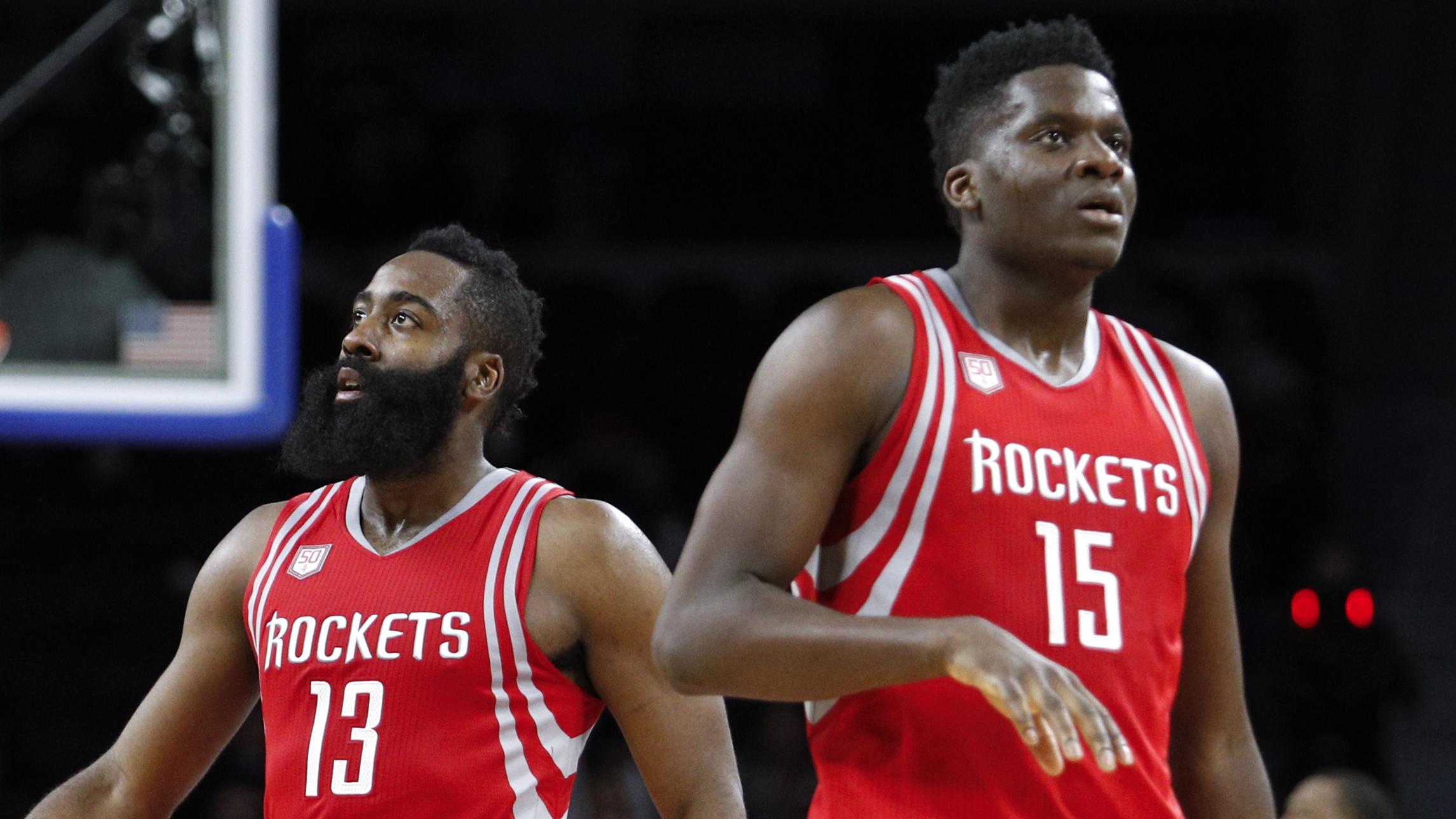
If you ask a casual basketball fan if they can name a Swiss national in the NBA they probably couldn’t. Some fans might retort with skepticism or wrongly assume it to be a trick question.
Surprisingly there is a small Swiss presence in the NBA, and one young talent is quietly putting together one of the most valuable single-season campaigns in recent league history. He’s 23 years old, and one of the most important cogs in what was the greatest offensive machine in league history through thirty games. His name is Clint Capella; the rim-running, lob-catching, defensive centerpiece that holds down the paint for the second-place Houston Rockets.
Likely every basketball fan on the planet is familiar with Houston’s All-Star backcourt, G James Harden appears to be the front-runner for the Most Valuable Player Award and G Chris Paul has played All-NBA caliber basketball at age 33 (when he has been healthy). A good majority of fans are likely familiar with some of the versatile wings that the Rockets have acquired in free agency over the last five seasons: F Trevor Ariza, G Eric Gordon, F PJ Tucker, F Luc Mbah Moute, and F Ryan Anderson, who have been intricately responsible for Houston taking a league-leading 43.6 three-point attempts per game. But few fans possess a true understanding of Capella’s game; and more importantly, his value, outside of his rim-rattling dunks and frequent appearances on SportsCenter’s nightly Top 10 Plays.
The beauty of Capela’s game is that it can be both easily transcribed through numbers and digested via the eye-test, a luxury that’s typically reserved solely for the league’s elite. When you watch Capela play, you consistently notice his impact on the game, whether it’s captured in the box score or not. Most importantly, his impact creates winning opportunities for his team on both sides of the court; which is particularly valuable for a Houston Rockets team that lacks a defensive identity. A great example of his defensive impact came earlier in the season against the defending Eastern Conference Champion Cleveland Cavaliers in late November:
The Future of the atlantic division
What does the future hold for the 76ers, Celtics, and the rest of the Atlantic?
--------------
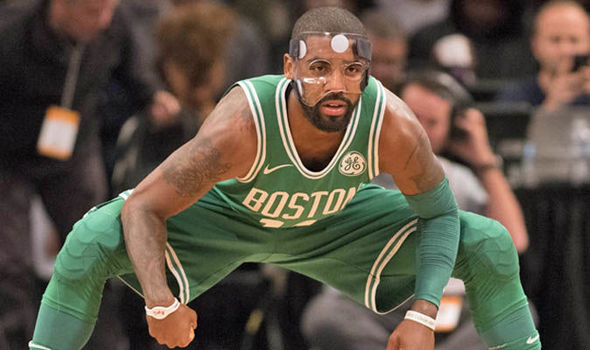
Boston Celtics
As this article is being written, the Cs currently sit with the best record in the entire Association and a healthy lead for the #1 seed in the Eastern Conference. Many of the elements that have spurred the Celtics’ great start have dominated the NBA media landscape: Kyrie’s semi-MVP level performance, Head Coach Brad Steven’s defensive command over a 15-man roster, Jaylen Brown and Jayson Tatum’s emergence as two of the league's most-promising rising stars, and Al Horford’s resurgence to All-Star level play. But there are many other factors at play behind the scenes in Boston that have made the Celtics’ quarter-season dominance possible.
Terry Rozier’s continued progression towards becoming one of the league’s top backup point guards has given the Celtics a much-needed stability on offense that they lacked mightily whenever All-Star guard Isaiah Thomas went to the bench during the 2016-17 season. Rozier’s TOV% -- an advanced metric that measures how many possessions the ball is primarily in a player’s hands and also ends in a turnover -- has declined steadily in each of his three seasons. He currently sits at a very modest 7.2% -- which has boosted his assist-turnover ratio up to 2.88 -- currently 20th in the entire league. A continued commitment to valuing the basketball in the half-court and an increased defensive energy-level has earned Rozier bragging rights as “top guard off the bench” status for the Cs.
Yet Rozier isn’t the only little-known savant in the Celtics lineup. The Cs are backing up their best-in-league record with the league’s best defense -- posting a defensive efficiency of 97.8 -- led by their three All-Defense candidates G Marcus Smart, F Jaylen Brown, and C Al Horford. Rookie F Jayson Tatum has been given tremendous praise for his offensive abilities -- and much deserved, since he is currently averaging 14 points per game and shooting 50% from beyond the arc -- but his ability to adapt defensively to Stevens’ system is the barometer of his basketball IQ and future NBA potential. If Tatum continues to handle his own offensively and is able to learn how to use his length to combat matchups against the league’s best perimeter scorers, he could be the star that leads the Celtics into their next era of excellence.
Brooklyn Nets
Somehow the Nets managed to escape being the doormat of the NBA without a single first-round draft pick for the past four seasons (and once again, they will not have it this June). As ESPN’s Zach Lowe beautifully documented in the spring, the culture within the Brooklyn organization has been a galvanizing force for a young ensemble of talent -- ninth youngest in the NBA to be exact -- in desperate need of direction. Head Coach Kenny Atkinson is slowly taking over Charlotte Hornets Head Coach Steve Clifford’s throne as “the king of under-the-radar unbelievably effective offensive sets”. For NBA nerds like myself, this is breathtaking to watch. The pace and movement is constantly in flux, giving Brooklyn's novice core of talent the autonomy and freedom to develop their own direction on the fly; an effective way to speed-up player development without sacrificing precious practice time.
This has been especially true for the Nets' hodgepodge of guards. Brooklyn's young backcourt trio of Spencer Dinwiddie/D’Angelo Russell/Caris Levert has been a main driver for the Nets’ limited-success thus far this season. Dinwiddie’s impact has been especially important on the offensive end -- when he’s in the game the Net’s offensive rating jumps from 103 to 110, meaning the Nets score 7 more points per 100 positions during his minutes. For reference, the defending NBA Champion Golden State Warriors lead the league with a offensive rating of 116. Russell and Levert have added a less-systemic offensive impact overall during their minutes, but they’ve provided value by being the only two healthy players on the roster (looking at you G Jeremy Lin) who are able to create their own shot in an auspicious manner. If the Nets want to make the leap to becoming a playoff team, both Russell and LeVert will have to improve their percentage from three -- they currently sit at 29% and 28%, respectively.
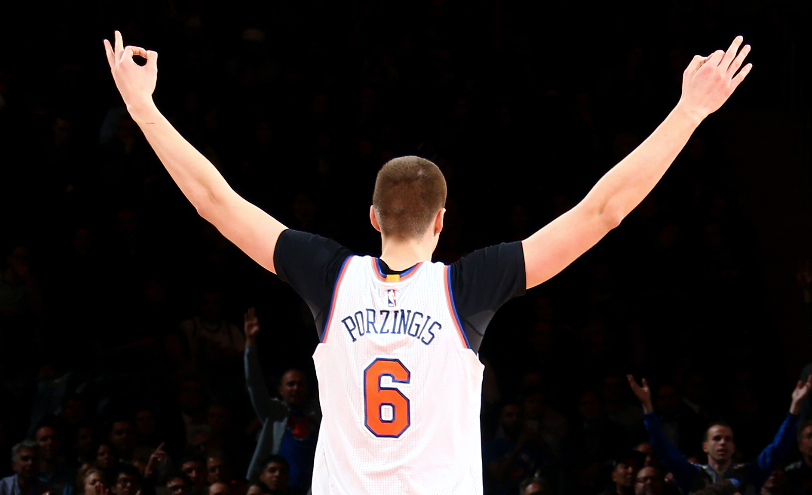
New York Knicks
Bring on the Kristaps Porzingis adoration, the young man has finally cemented his unicorn status. Likely the only positive addition Phil Jackson made to the Knick organization during his tenure from 2014 – 2017, Porzingis has taken his elite-level stretch four game to the All-NBA level thus far in his third season. Porzingis posts an unreal 34% usage so far this season – which accounts for the percentage of possessions a player is directly involved in that result in a shot attempt, foul shot, or turnover -- while maintaining historic efficiency from the field at 49% overall and 39% from three. While the Knicks haven’t necessarily dazzled so far this season -- they sit at .500 through 24 games -- they have vastly exceeded expectations coming into this season following the loss of All-Star F Carmelo Anthony to the Oklahoma City Thunder.
Rookie G Frank Ntilikina is proving his defensive worth early in his NBA campaign -- he’s averaging a 3.5% steal rate thus far this season -- a skillset the Knicks have sorely lacked in their recent tenure under Head Coach Jeff Hornacek. His willingness to guard baseline-to-baseline and hound the other team’s best ball handler, including Hall-of-Fame talents like LeBron James, shows that he has the ‘bulldog’ factor that is a common characteristic of many great defensive guards.
The Knicks post an average offensive rating of 105 -- much higher than anticipated going into the season -- which bodes well for rounding out the roster in the coming years. The Knicks’ biggest problems going forward come from their convoluted roster construct. General Manager Scott Perry and President Steve Mills will have to find away to relieve the payroll of toxic contracts (they've currently devoted 44% of their entire rents to F Joakim Noah, G Tim Hardaway Jr., and G Courtney Lee). If the Knicks have any interest in joining the 2018 LBJ Sweepstakes, or bargaining for Klay Thompson, Demarcus Cousins, or any other big names the next two summers for that matter, they will likely have to forgo a precious first-round pick or two to clear the needed space.
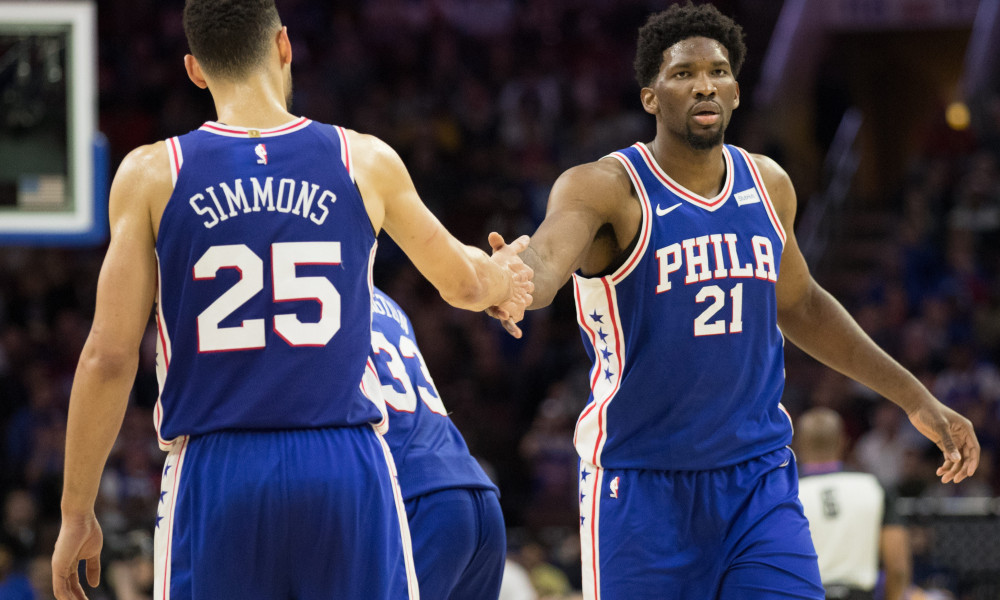
Philadelphia 76ers
76ers fans rejoice; phase one is complete! The young pieces are proving that when healthy they are historically great. I don’t typically like to speak in hyperbole, but Ben Simmons and Joel Embiid have played like the 21st-century versions of Magic Johnson and Hakeem Olajuwon through the first quarter of the 2017-18 season. Outside of sustained health, there are a few factors that will determine if the 76ers are a fringe-playoff team for the next five years, or if they are able to push the envelope and make their first Eastern Conference Finals since 2001.
To gain the experience and development to compete for a title, Head Coach Brett Brown is going to have instill good defensive habits into his young guys this season. Some of the 76ers already have a tremendous ability to defend individually and within the team space -- C Joel Embiid and F Robert Covington are model citizens for the rest of the roster, and Ben Simmons is at least proving to be a good defender on paper. Embiid is the quarter-season Defensive Player of the Year pick hands down. His quick instincts and uncanny ability to protect the paint have already been proven to be hall-of-fame level -- his 3.9 blocks per 36 minutes through his first fifty games as a 76er is higher than both Dikembe Mutombo and Hakeem Olajuwon’s recordings through their respective first fifty games as pros.
Robert Covington is the truest example of a 3-and-D talent through the first 25 games of the season (his 1.6 steals per game being 17th in the league this season). He matches his intensity on the offensive end by locking down the best perimeter offensive threats; having already squared off against Kevin Durant, LeBron James, and James Harden this season. Rookie F Ben Simmons posts an incredible 2.3 steals per game as well -- which ranks second in the entire league -- but he still has to prove he can defend at a high level for forty minutes a night to compliment his Rookie of the Year offensive dexterity. With Simmons, the eye-test doesn’t necessarily back up the advanced statistics.
The biggest question-mark, which will likely determine if the 76ers are a perennial 6-seed or a conference title contender, is “what will become of last June’s #1 pick?” We haven’t seen Markelle Fultz in a basketball uniform since late October, when he nearly broke your television set with his hideous Bill Cartwright-esque free-throw form. During his freshman year at the University of Washington, Fultz showed flashes of NBA All-Star level production (even when he appeared to be half-engaged in semi-competitive PAC-12 conference games). Fultz shot an incredible 40% from three as a freshman, and led the Huskies in every major offensive category besides rebounds. Yet he has been sidelined by the ever-reticent 76er training staff for a undisclosed shoulder injury the past six weeks. He’s still nineteen years-old. If Fultz is able to regain his health, rework his slightly skewed jump shot, and find his place as the off-guard next to Ben Simmons point-forward style, the 76ers will have all the pieces needed to make playoff pushes into June throughout the 2020s.
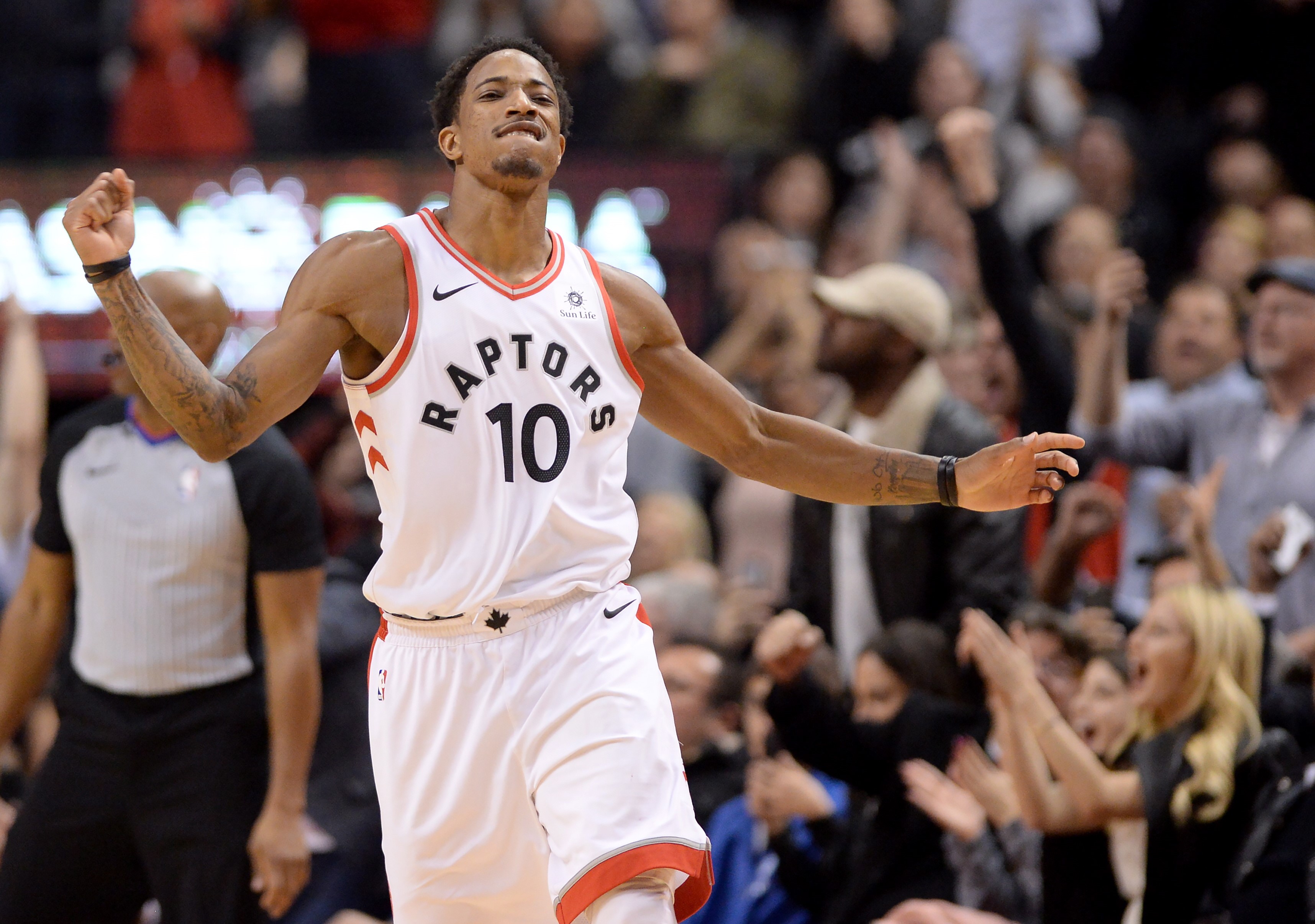
Toronto Raptors
The last team in the division is by far the most difficult to predict. The Raptors seem to be stuck in a paradox of playoff disappointment and postseason ineptness, and simultaneously transitioning towards becoming the most forward-thinking efficient offense in the Eastern Conference. Their two best players -- G Kyle Lowry and G DeMar DeRozan -- are past their primes. They’ve failed to hit on recent free agent signings like F PJ Tucker, F Serge Ibaka, F Rudy Gay, and F Patrick Patterson. They haven’t been able to even slightly compete with the Cleveland Cavaliers since LeBron James returned in June 2014, having been eliminated by the Cavs twice in the past three seasons. And yet, Head Coach Dwane Casey’s team is excelling and attracting serious consideration and comment from both traditional and non-traditional media outlets.
What changed in the past 6 months? The entire Raptor offense. Last season the Raptors ranked 24th in the league in pace, 22nd in 3-point attempts per game and last in assists per game; all indicators of a team playing in an outdated system that will struggle against the most-simplistic modern NBA defensive schemes. This season? The Raptors are 11th in pace, 6th in 3-point attempts, and 4th in assists. Complete revisions of offensive strategy don’t typically occur this dramatically in professional sports, professional athletes are creatures of habit and it takes time to iron-out old tendencies that can cause players to drift back towards their traditional ways -- but Casey has been able to reach his roster and spur change over night. The real question for the Raptors and Casey will be whether they can rely on their new offensive structure for success in the 2018 playoffs and beyond
And even though the 2017-18 season has gotten off to as good of a start as possible for Canada’s team, it still doesn’t provide a clear picture of where the Raptors will be in April and May; or three-to-five years for that matter. Toronto does boast one of the youngest stockpiles of talent in the entire conference -- G Delon Wright, G Norman Powell, F Jakob Poeltl, and F OG Anunoby have all proven themselves -- who can vouch for the Raptors’ future. But only Powell has proven to be a viable rotation player on the biggest stage. Toronto also doesn’t bode well as a free agency destination for a variety of reasons -- financial disincentives from being located internationally, a lack of playoff contention, an aging roster; to name a few. How Lowry and DeRozan's respective games age over the next season and three-quarters will cast a bright light on the Raptors future -- and if Toronto's young talent doesn't mature and produce as expected -- the Raptors could find themselves at the bottom of the division before too long.
Washington Huskies 2017-18 Season Preview
How will the Dawgs fare in the PAC-12 under first-year Head Coach Mike Hopkins?
--------------
Roster & Schedule
2017-18 Roster
Projected Starting Five
Complete Schedule
*Featuring KenPom Rankings
Key Matchups
November. 10 – Belmont: First regular season game in the Hopkins-era.
November 16 – Providence: 2K Classic in Madison Square Garden against a fringe-Top-25 contender. Huskies may be the weakest team in the field, while Providence and Virginia Tech project as NCAA Tournament bids.
December 10 – Gonzaga: Renewing series with cross-state rival. UW will be a significant underdog.
January 6 – @ WSU: One of the few road games UW should win in conference and Huskies will likely need to win to avoid 0-3 start in Pac-12.
January 11 – California: Home opener swing against the Bay Area schools following three road games to start conference play.
January 20 – @ Colorado: UW will likely need to split Utah/CU here to have realistic shot of finishing in the top half of the conference.
February 10 – @ Oregon St.: Likely the most winnable contest in a tough five-game stretch against Arizona schools, road matchups in Oregon before getting Utah at home.
Preview
KenPom Ranking – 130
CBS All-351 Ranking – 141
PAC-12 Preseason Media Poll Ranking – 10/12
New Era, New Identity
The Huskies are entering uncharted territory following the exit of Lorenzo Romar, who held the reigns at UW for 15 years and was the longest tenured coach in the Pac-12.
Enter Mike Hopkins. Hopkins spent over 20 years behind future Hall of Fame coach Jim Boeheim at Syracuse and, with that, brings Cuse’s 2-3 zone defense to a program that played its’ best basketball when employing high man-to-man ball pressure. The new regime inherits a team that struggled mightily on the defensive end a year ago, as the Huskies allowed opposing teams to shoot 46-percent from the field and 40-percent from beyond the arc. There will be significant growing pains establishing a new defensive culture, particularly in the mold of a zone defense that requires a deep understanding of the scheme. Freshman Hameir Wright, the 2016-17 New York Gatorade Player of the Year and an early recruiting gem of Hopkins, described the new defensive gameplan as the toughest aspect of adjusting to college ball. “It really has to come down to a science,” said Wright in an interview with Kim Grinolds for Scout.
Speaking of Wright, Hopkins will rely heavily on three freshmen, somewhat of a rare occurrence found in teams with coaching staff overhauls. Wright, the coveted big with a seven-foot wingspan, is a prototypical defender at the bottom of the zone. Garfield High School product Jaylen Nowell will receive the lion’s share of the minutes as the off-ball guard, while Nahziah Carter, a former Dayton commit before Archie Miller’s departure to Indiana, bolsters the Huskies’ versatile rotation on the wing.
Backcourt
The Huskies need a sizeable leap in efficiency from David Crisp, the top returning scorer from a year ago. Crisp will run point for UW and likely take the vast majority of off-the-dribble three pointers on the offensive side of the ball. The junior’s defense is key as he looks to play a lot of minutes given the short rotation. It’s not particularly difficult to throw numerous statistics on both ends of the court that Crisp should improve on (i.e. holding the worst defensive rating of any rotation player last season - 117.9 points allowed per 100 possessions), however, his true value will be demonstrated in the ability to be pesky at the top of zone and a leader in generating a ball-movement culture on the offensive end.
Freshman Jaylen Nowell will start immediately and may already be the most efficient perimeter scorer on the roster. The Seattle native has a mature mid-range game and strong enough frame to not get bumped off his spot. Due to the lack of guard depth on the roster, Nowell will get an early chance to develop his skills creating shots for teammates as he projects to be the primary ballhandler when David Crisp is on the bench. Lineups with Nowell at the point will give a sneak peek into the havoc Hopkins’ zone can cause with length at every position.
Michael Carter III is the fourth freshman lurking in the shadows and his role this season remains to be seen. Carter III took a year off following his senior year, which tends to be a helpful mechanism to flatten out the learning curve for freshmen. The former University of San Francisco commit already looks to be a plus shooter, but his ability to defend and make plays for others will be his key into the rotation on a team short on backcourt depth.
Smallball Bigs + Wings
Washington’s deepest position is the wing, as returners Matisse Thybulle, Dominic Green and Carlos Johnson pair with newcomer Nahziah Carter. Conversely, these four should end up with significant minutes at three positions (2-3-4). On defense, it is worth following who is able to make the most impact on the bottom of the zone and, when the team turns to man defense, who is able to stick as a small-ball four. This group needs to be comfortable attacking the glass and rebounding in traffic as well due to the nature of rebounding gaps in a zone. On offense, Thybulle is the only plus-level three-point shooter and everyone else will need to prove their ability to consistently knock down shots.
Junior Matisse Thybulle has shown flashes as a three-and-D wing who could see the next level by putting together a well-rounded campaign. The hyper-athletic wing has the best defensive rating (110) of any returning player while knocking down over 40-percent of his threes. Thybulle’s shot selection fits the modern mold, hitting a 50/50 split between two-point and three-point attempts last season with the bulk of his threes coming from the corners. The junior’s handle, attacking off the bounce and passing discipline are areas for improvement, but Thybulle has the skillset to make a leap this season.
Dominic Green has the ability to be a tough shot maker for the Huskies, though his splits last season would not lead anyone to believe that was the case after shooting 21-percent from the field and 17-percent from three in conference play. Green is a long, rangy wing capable of creating his own shot off the dribble and should see opportunities to be a spot-up three-point shooter moving forward. However, his wiry frame allows for teams to push him around a little, both off his spot on offense and on the defensive end. The junior had the worst net rating (-25.4 points per 100 possessions) of any rotation player last season, but showed enough potential to be a solid rotation player in Hopkins’ more structured system.
Carlos Johnson became somewhat of a fan-favorite during his freshman campaign due to a willingness to dive on the floor for loose balls and (attempt) to poster anyone in his path on offense. The sophomore plays much more like a 215-pound big than a 6’3” perimeter player, as he might be the bulkiest player on the roster and even found minutes as the small-ball four last season. Johnson’s three-point shooting improvements (29-percent in conference following a sub-20 mark in non-conference) give a little hope to his ability to play on the perimeter, however, he has a long way to go before becoming an above-average shooter. In addition, Johnson was not much more effective than Green in the holistic metrics department, finishing with a -22.1 net rating, but I’d expect his value to be more intangible due to his energetic and scrappy nature (surely appreciated by Hopkins).
Nahziah Carter gives the Huskies another long, bouncy wing that can defend multiple spots in the zone. Carter played with a lot of confidence in high school (read into this however you want) and is a plus athlete both vertically and with the first step. His shot development is something to monitor throughout the season, both in selection and ability to catch-and-shoot. There is typically a rebounding concern for freshmen that were primarily perimeter players at their previous level, but Carter’s height and athleticism give him an advantage in this area.
Bigs
How Hopkins defines “big man” will be a fun development throughout the season. Noah Dickerson is, in every facet, a traditional big that is able to bruise below the basket and extend a mid-range game. Hameir Wright is a slightly modernized big: extremely lanky, athletic, able to run the floor well without necessarily demanding the ball. Both Dickerson and Wright will see plenty of minutes this season, but it would be surprising to see them on the floor at the same time unless the coaching staff felt the need to go super big while sacrificing spacing on the offensive end (not ruling this out). This decision may very well come at the expense of Sam Timmins and Devenir Duruisseau, two bigs from the Romar-era that struggled to get their footing. Timmins projects third on the depth chart here in case Dickerson and Wright are in foul trouble.
Dickerson will shoulder the offensive load and showed he was capable of this during Markelle Fultz’ absence in conference play last season. He is the only returner the can claim a positive net rating from last year (119.5 O, 111.5 D) and improved his efficiency throughout the year, shooting 55-percent in conference play to close the season. Expect Dickerson’s shot volume to hit a double-digit average, as he will likely end up as the go-to option on offense. The junior is limited in his ability to protect the basket and create separation due to a minus wingspan and vertical athleticism, but his above-average footwork on both ends helps minimize these risks.
Hameir Wright may very well end up as the highest impact player off the bench by the time conference play rolls around. Wright moves very well for his size and can get off the ground quickly on both ends of the floor. The 6’9” big showed an ability to work a little off the dribble in high school, but may not be enough of a shooting threat at this stage to draw much on-ball attention on the perimeter and certainly needs to tighten his handle. Either way, his extreme length and ability to get off the floor will lead to opportunities in the lane on offense and rim-protection on defense. A “good” freshman year for Wright would mean he was a strong plus on defense while able to finish around the rim at a high rate on the other end.
Timmins and Duruisseau look to be relatively buried on the depth chart. Timmins was able to make important strides last season and demonstrated a soft touch around the basket, but he’s simply built to play a much different style than the rest of the rotation. It will be relatively interesting to watch him play in Hopkins’ system, as the near seven-footer definitely clogs the lane. Duruisseau is a strong rebounder, but his shortcomings on offense are detrimental for a team that will likely have enough struggles spacing and scoring on that end as is.
Expectations
Hopkins’s opening show with the Huskies will be a bumpy ride and a bottom-half of the conference finish is very likely. The coaching staff has shown a bit of blueprint in its recruiting for ’17 and ’18, but this roster does not entirely fit that mold (to be expected after regime changes). On offense, the Huskies need to develop some sort of identity and have the personnel to try pace-and-space given the wing players’ ability to consistently catch-and-shoot. Ultimately, the team might struggle to score efficiently. The defensive transition to zone will have significant growing pains, though there is enough length on the roster for it to be interesting. The exhibition game against Saint Martin’s was a fascinating early use-case, as the Huskies made their run employing high-pressure man-to-man defense. Washington's defensive culture development vs. competitive drive will be a tug-of-war as long as this group is more effective in man, but the transition wouldbe accelerated by an effective ¾ or ½ court trap falling back into a zone.
Welcome to a new era!
Gonzaga Bulldogs 2017-18 Season Preview
How will the Zags fare against their arch-rival Gaels and the rest of the nation?
--------------
Roster & Schedule
2017-18 Roster
Projected Starting Five
Complete Schedule
November 10th vs. Texas Southern
November 14th vs. Howard
November 18th vs. Utah State
November 23rd vs. Ohio State
November 24th vs. Florida/Stanford*
November 26th vs. Duke/Portland State/Butler/Texas*
November 29th vs. Incarnate Word
December 1st vs. Creighton
December 5th vs. Villanova
December 10th @ Washington
December 16th vs. North Dakota
December 18th vs. IUPUI
December 21st @ San Diego State
December 28th vs. Pacific
December 30th vs. Santa Clara
January 4th @ Pepperdine
January 6th @ Loyola Marymount
January 11th vs. Portland
January 13th vs. San Francisco
January 18th vs. Saint Mary’s
January 20th @ Santa Clara
January 25th @ Portland
January 27th vs. San Francisco
February 1st vs. San Diego
February 3rd vs. Brigham Young
February 8th @ Pacific
February 10th vs. Saint Mary’s
February 15th vs. Loyola Marymount
February 17th vs. Pepperdine
February 22nd @ San Diego
February 24th @ Brigham Young
Key Matchups
November 23 vs. Ohio State
November 24 vs. Florida/Stanford*
November 26 vs. Duke*
December 1st vs. Creighton
December 5th vs. Villanova
December 21st @ San Diego State
January 18th vs Saint Mary’s
February 10th @ Saint Mary’s
February 24th @ Brigham Young
*Projected based on PK80 tournament results
Preview
KenPom Ranking – 20
Associated Press Pre-Season Ranking – 18
USA Today Coaches Poll Pre-Season Ranking – 19
The 2018 Gonzaga Bulldogs should be the most interesting and perplexingly inconsistent group that Mark Few has had since the infamous 2015-16 team that almost ended the Zags’ then sixteen-year tournament streak. But, these Zags won’t scare you in the same way that that group did, and they may have even more talent -- which is slightly crazy considering the 2015-16 frontcourt was led by current NBA talents F Kyle Wiltjer and F Domantas Sabonis.
These Gonzaga Bulldogs will keep you on the edge of your seat for two main reasons: the aggregation of a variety of skilled young players and the intraconference competition coming from the Saint Mary’s Gaels; the second of which being enough to make any long time bleed-blue-and-red Gonzaga basketball fan shutter. Gonzaga fans young and old remember the 2010-2012 stretch when Randy Bennett’s inaugural Aussie-based teams clinched the West Coast Conference Tournament Championship crown from Gonzaga twice in three years. Gael is as condemned a four-letter word as you’ll find within the city limits of Spokane, WA.
And it seems like this year almost every major media outlet is picking Saint Mary’s to be the strongest team in the West Coast Conference, but here are the reasons why those prognostications are wrong...
Front Court Depth
The Zags once again present one of the most menacing frontcourts in the entire country, which will be essential for Gonzaga’s success in marquee matchups against some of the nation’s best teams (especially against rival Saint Mary’s). The Zags’ trio of F Johnathan Williams, F Killian Tillie and F Rui Hachimura presents a variety of problems for opposing defenses -- most notably their incredible length and ability to stretch the floor on offense. Hachimura holds the potential to turn the Zags into another one of Few’s elite-level teams come March (and rightly so given what he showed the world this summer), but it will be Williams who becomes the go-to option inside for Gonzaga in close contests that make-or-break a season. If the Zags want to win another West Coast Conference crown over the Gaels, Williams will need to turn in production around the 18 points and 10 rebounds a game mark and challenge double-double machine F Jock Landale of Saint Mary’s for Conference Player of the Year rights.
Young Talent
We already mentioned Hachimura above, but there is a tremendous amount of young and talented newcomers that could elevate Gonzaga into a top-ten ranking by the start of January. The first of these is Zach Norvell Jr., who is one of the most-highly anticipated freshman in Gonzaga history because of his roots (South Chicago) and because he comes from outside the normal Gonzaga recruiting circle (he attended Simeon Academy -- the birthplace of NBA stars Derrick Rose and Jabari Parker). As a redshirt freshman, Norvell arrives with the exact skill-set that has served as the binding for great Gonzaga teams in the past -- the ‘Three and D’ wing who can stretch opposing defenses with his shot on offense and contain high-level perimeter production on the defensive end. However, given that Norvell redshirted last year it will be tough to guarantee consistent production from the freshman in his first go around at Division I basketball. The other name that could contribute is fellow red-shirt freshman C Jacob Larsen, who serves as the most physically-opposing feature Head Coach Mark Few possesses in his arsenal of big men. Larson provides the Zags with the option to wield an extra-big lineup when he plays along side two members of the Tillie-Williams-Hachimura trio, giving the Zags a versatility that few in the entire country possess. However, don’t expect Larson to make a Przemek Karnowski type impact this season; it will take time to mold the six-eleven freshman into a viable threat on both ends of the floor.
Traditional Staples
This Gonzaga group features many of the common strengths we’ve come to expect from Mark Few led teams: strong team defense, the ability to dominate the glass, and veteran guard play. More so than in recent years, the Zags feature an incredible amount of length in their roster this season -- particularly in the case of Hachimura, Norvell, and Melson -- who should be the defensive stalwarts that wreak havoc as help defenders against weaker opponents. As mentioned above, Gonzaga features one of the deepest frontcourts in the country, which should allow them to dominate the rebound battle and set the pace of many contests against second-tier conference opponents. The Zags’ guard play will likely be the determining factor in many of their high-level matchups against the country’s elite (specifically against the Creighton Jays, Saint Mary’s Gaels, Villanova Wildcats, and Duke Blue Devils). Junior G Josh Perkins and senior G Silas Melson must shoot efficiently from the perimeter and limit turnovers in the low-teens if the Zags expect to compete in these matchups. If Few is able to wrangle in both -- who have previous tendencies to be wildcards valuing the basketball -- then watch for the Zags to make a very deep tournament run next spring.
Even though the expectation is that Saint Mary’s will take the regular season West Coast Conference crown from the Zags this year, Gonzaga will reap revenge in the Conference Tournament in Las Vegas and ultimately have a more complete run in March than the Gaels.
For Fun
Breakout Candidate
To prevent picking the obvious low-hanging fruit that is Rui Hachimura for this award, the second-most likely candidate to shine above expectation this winter for the Zags is freshman Corey Kispert. Kispert hails from just outside the city limits of Seattle and attended renowned AA basketball powerhouse King’s Academy; a perennial contender in the WIAA Washington State Basketball Tournament. But just Kispert’s background alone doesn’t paint a picture of his abilities. As a 6-6, incredibly athletic, and versatile wing who will be one of the conference’s best backup forwards, he has all the tools to make an immediate impact at the next level. The biggest question marks for Kispert in his first season as a Zag will be the amount of time he actually ends up actually seeing on the floor and his ability to stretch the opponent’s big men beyond the restricted area and consistently hit open 10-12 foot jump shots (something he had little problem doing at the high school level). If he is able to gain a sense of his role in this loaded Gonzaga frontcourt, Corey Kispert could not only be the breakout candidate for this Zags squad but a sneaky contender for West Coast Conference Freshman of the Year honors.
Unknown Bench Contributor
Characteristic of a top-notch mid-major program, the Zags have a multitude of players who could explode onto the scene and have an unexpected hand in a share of Gonzaga wins this season. However, the mostly likely contributor among the crop is a freshman who may not even play a minute this year -- guard Jesse Wade. Wade’s story is full of twists and turns -- a now 20-year-old freshman who spent the last two years on a mission trip in France -- Wade actually committed to Gonzaga back in 2013, when Gonzaga’s backcourt was at the helm of Zag legends Kevin Pangos and Gary Bell Jr. The last time Wade played organized basketball as a high-school senior he averaged 28 points per game, shot 45% from behind the arc, and was named the Utah State Player of the Year. Wade was sidelined for Gonzaga’s exhibition opener last Friday with what Head Coach Mark Few has referred to as “a shoulder that sublexes here and there”. Given this diagnosis, and the fact that even Few indicated it could be a while before Wade returns to the court, there is a decent chance the freshman could redshirt this season and suit up for the Zags in 2018-19. But if he is able to return to action this winter, watch for Jesse Wade to light up the scoreboard from behind the arc for the Zags.
Expectations
Record – 27-5 Regular Season, 3-0 Conference Tournament, 30-5 Overall
Resume Wins – Florida/Stanford*, Creighton, @ San Diego State, @ Brigham Young
Losses – Duke*, Saint Mary’s (2x), Villanova, @ San Francisco
Regular Season Conference Title – No
Conference Tournament Champion – Yes
NCAA Tournament Bid – Yes
NCAA Tournament Seed – 6
NCAA Tournament Round – Sweet Sixteen
Players that Declare for the 2018 NBA Draft – F Johnathan Williams, F Rui Hachimura
*Projected based on PK80 tournament results
Season preview for the casual Nba fan
The 2017-18 Season
--------------
Teams
In alphabetical order, skip to your favorite
Atlanta Hawks
Summary: 13th in the Eastern Conference, Lottery-Projected
What to Watch: Not a lot. The Hawks went from 60 wins in 2014-15 to an abysmal team whose “franchise player” is an uneasy and unnerving German 20-something with Wiz Khalifa’s 2013 hairstyle. The most watchable aspect of this team is their young talent -- namely second-year F Taurean Prince and rookie F John Collins -- and late-season potential to see how the two can leave their mark on an otherwise completely uninteresting team.
For Fun: The Hawks’ uniforms are equally as ugly with a swoosh as they are with three stripes.
Boston Celtics
Summary: 1st in the Eastern Conference, Eastern Conference Finals
What to Watch: A lot, let’s see if we can cover the highlights. 1) The plethora of talent at the forward position -- which features Utah transfer Gordon Hayward, rookie Jayson Tatum of Duke University, and Marcus Morris. 2) The integration of G Kryie Irving, and the opportunity to see how he performs outside of the shadow of LeBron James. 3) The loaded Celtic bench, which features a talented mix of young guards in Marcus Smart, Terry Rozier, and Jaylen Brown. 4) The ability of Head Coach Brad Stevens to work his magic to get all eight to ten rotation players valuable minutes each night, once again bring the Celtics the ever-irrelevant first seed in the East, and secure his first NBA Coach of the Year award.
For Fun: Washington State University graduate Aron Baynes is considered a strong free-agency signing in 2017.
Brooklyn Nets
Summary: 11th in the Eastern Conference, Lottery-Projected (no pick)
What to Watch: Actually.. something. The backcourt situation will be interesting in Brooklyn this year because of the addition of Lakers G D’Angelo Russell. As a result, Head Coach Lionel Hollins has to find a way to combine Russell’s defensive ineptness with G Caris LeVert’s budding talent and G Jeremy Lin’s ability to dazzle a New-York crowd. Also, if you’re interested in seeing how valuable the Cleveland Cavaliers’ 2018 lottery pick will be turn on the Yes Network on some rainy weekday nights this winter.
For Fun: This team is full of players who made names for themselves in the NCAA Tournament during their college years, including Isaiah Whitehead of Seton Hall University who was absolutely shut-down by the Gonzaga Bulldogs in the first round of 2015-16 Tournament.
Charlotte Hornets
Summary: 7th in the Eastern Conference, First-Round of the Eastern Conference Playoffs
What to Watch: Kemba Walker. The electric guard who once captured our hearts at the University of Connecticut is doing the same thing at the professional level. Watch for Kemba to continue his rise and carry a team of misfits -- including poisonous addition C Dwight Howard -- back to the playoffs. F/C Cody Zeller is also a player to watch for his potential to create havoc in the pick-and-roll with Walker in the second unit, making him the strongest candidate for the NBA Sixth Man of the Year award. Rookie guards Malik Monk and Dwayne Bacon will also be fun to watch when they get hot from outside in random mid-season games.
For Fun: Owner Michael Jordan (yes, that Michael Jordan) told Cigar Aficionado magazine that he smokes six cigars a day.
Chicago Bulls
Summary: 15th in the Eastern Conference, Lottery-Projected
W̶h̶a̶t̶ When to Watch: When they play the Warriors, Rockets, and Cavaliers. But in all seriousness the Bulls do feature a variety of prominent under-the-radar young players including: F Denzel Valentine, F Bobby Portis, and C Cristiano Felicio. There is chance that Minnesota transfers G Zach LaVine and G Kris Dunn (whom I may or may not have thought was the best 21+ year-old guard to come out of college since Stephen Curry… yikes.) make a transitional and unexpected leap as defensive and offensive talents, respectively. The chances aren’t good.
For Fun: The Bulls have five point guards on their roster. That’s a lot.
Cleveland Cavaliers
Summary: 2nd in the Eastern Conference, 2018 NBA Finals
What to Watch: The most intriguing season of F LeBron James’ career. If you love watching LeBron, this will be the season to purchase NBA League Pass. With a deplenished and historically-fragile roster (looking at you G Derrick Rose, G Dwayane Wade, and F Jeff Green) constructed around James, we are lucky enough to be given another year to witness 2007-Pistons-Game-God-Mode LeBron. While the Cavaliers won’t be inspired enough to grab the first overall-seed in the Eastern Conference for a second consecutive year (why should they?) the additions of G Isaiah Thomas from the Celtics, Rose, and Wade will make LeBron’s seven-month backpacking trip around the USA more watchable than just about any other aspect of NBA basketball in 2017-18.
For Fun: Congratulations to F Tristan Thompson for knocking up Khloe Kardashian.
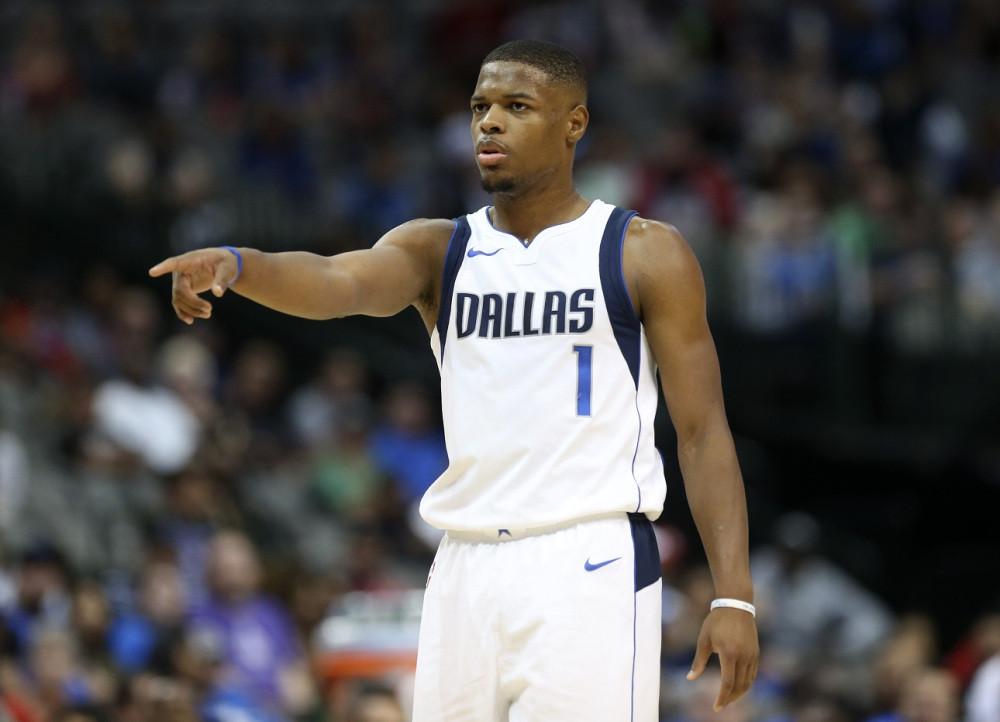
Dallas Mavericks
Summary: 12th in the Western Conference, Lottery-Projected
What to Watch: Dennis Smith, Jr. The rookie guard from North Carolina State has the potential to be the most-explosive and entertaining guard since Derrick Rose when he had both of his ACLs. With Head Coach Rick Carlisle running the show and an incredible absence in the Mavericks backcourt, Smith could not have found himself a better home last June. Watch for the young rookie to make the Mavs’ otherwise vanilla offense pop and frequently appear on nightly episodes of SportsCenter this winter.
For Fun: I’m pretty confident C Nerlens Noel’s hair grows steadily throughout the regular season. Can someone please watch for and document this? Thanks, NBA Reddit.
Denver Nuggets
Summary: 5th in the Western Conference, 1st-Round of Western Conference Playoffs
What to Watch: Nikola Jokic and Paul Millsap. The twenty-two year-old Serb and the thirty-two year-old free-agent veteran signee make for an odd pairing, until you realize their tremendous vision, footwork, and absolute ineptness for defensive basketball. The 2017-18 Nuggets will play a similar style to Denver’s 1980s “run-and-gun” sets where they looked to score one-hundred thirty-fix points per game and give up one-hundred thirty. This season will be a somewhat similar story, with a lot of young and exciting offensive firepower ready to explode onto the semi-national stage -- specifically G Gary Harris, G Jamaal Murray and F Juan Hernangomez. If you like watching all offense and no defense, the Nuggets will be your team this season.
For Fun: Since Carmelo Anthony used to play for the Nuggets and is the biggest meme of the summer, here’s a video of him laying on the floor during the middle of an actual regular-season NBA game. Melo made roughly $183,000 that game, which equates to $635 while he was laying on the floor.
Detroit Pistons
Summary: 9th in the Eastern Conference, Lottery-Projected
What to Watch: Luke Kennard. Just kidding, he’s one of the more overrated NBA prospects in recent memory. The most entertaining aspect of the Pistons 2017-18 NBA season will likely be when an internal fight breaks out between G Reggie Jackson and ‘X player’, or when C Andre Drummond grabs 25 rebounds and the Pistons lose by twenty-five to the Memphis Grizzlies. But in all seriousness, watch for Bellarmine Prep (Tacoma, WA) alumnus G Avery Bradley’s incredible ability to impact both sides of the floor each night. After being the third or fourth option in Boston the last four seasons, it will be refreshing to see Bradley become a focal point on an NBA team.
For Fun: C Andre Drummond dated Jennette McCurdy -- one of the stars of Nickelodeon’s iCarly -- for five days.
Golden State Warriors
Summary: 1st in the Western Conference, 2018 NBA Champions
What to Watch: It’s quite likely that every single person reading this has some understanding of this team’s construct. Household names G Stephen Curry, G Klay Thompson, F Andre Iguodola, F Kevin Durant, and F Draymond Green will continue to rule the NBA as kings for another season and may soon be considered the greatest assembly of basketball talent all-time. The most incredible (and frightening) facet of the 2017 NBA Champion Golden State Warriors is that they improved their roster this past summer by retaining their entire championship core and adding known-shooters G Nick Young and F Omri Casspi to an already incredibly-potent offense.
For Fun: Klay Thompson’s new signature sneaker commercial.
Houston Rockets
Summary: 3rd in the Western Conference, Western Conference Finals
What to Watch: How Harden shares the spotlight. After Head Coach Mike D’antoni masterfully implemented his up-tempo Phoenix Suns offense with Harden as the primary ball handler, it will be interesting to see how he meshes with soon to be Hall-of-Famer G Chris Paul. The most intriguing aspect of the 2017-18 Houston Rockets will be seeing if General Manager Darryl Morey makes another move sometime prior to the mid-February trade deadline to cement the Rockets as the second-best team in the Western Conference.
For Fun: Here everything you need to know about one of the NBA’s best mascots, Clutch the Bear.
Indiana Pacers
Summary: 10th in the Eastern Conference, Lottery-Projected
What to Watch: The beginning of the post-Paul George era. After the grandiose departure of F Paul George and the exit of General Manager Larry Bird, the Pacers are officially in full rebuild mode. Likely to be very near the bottom of this year’s League Pass Rankings, the Pacers should be fairly unwatchable outside of the occasional flash of potential All-Star level talent from C Myles Turner. The Pacers got one of the worst returns for an All-Star caliber player in recent memory, likely only topped this century by Oklahoma City’s inconceivable return for James Harden in 2012. Mostly, watch to see how many more games folklore Seattle SuperSonics guard and Indiana Head Coach Nate “Mr. Sonic” McMillan lasts at the helm. The prediction is right around fifty.
For Fun: Always remember this Paul George commercial featuring former University of Oregon G Joe Young.
Los Angeles Clippers
Summary: 6th in the Western Conference, First-Round of the Western Conference Playoffs
What to Watch: Blake Griffin as the team’s driving force. Much light has been shed on the “toxic” environment that was building between G Chris Paul and other stars on the team. 76ers G J.J. Redick admitted as much about the locker room environment after departing the team this summer. With Blake Griffin finally getting a chance to prove he isn’t the most-overrated player in the NBA, it will be interesting to see how the additions of G Patrick Beverly, F Sam Dekker, G Lou Williams and F Montrezl Harrell fill the scoring and defensive stability the Clippers found in Paul for the last six seasons. Personally, I’m still a little uneasy about G Austin Rivers being any NBA roster’s sixth man.
For Fun: F Blake Griffin is dating Kendall Jenner and they look hilarious together. This is the last Kardashians reference. I promise.
Los Angeles Lakers
Summary: 13th in the Western Conference, Lottery-Projected
What to Watch: A lot. The Lakers are the second-most interesting not-very-good young team to watch this season in the NBA, behind the wonderfully constructed Philadelphia 76ers. Not only is headliner G Lonzo Ball likely to make every Lakers fan’s dreams come true and more, but sophomore F Brandon Ingram is looking to impress after an over-hyped lackluster rookie season. All internal accounts within the Lakers organization have suggested his offseason progress was monumental. F Julius Randle is also an incredibly-interesting player to watch this season, since he has showed flashes of brilliance in each of the last two seasons after sustaining serious injuries throughout his NBA career. Randle has never played with a passer like Ball during his time with the Lakers, which should help to showcase his talent and the body he developed this past summer.
For Fun: There’s a Facebook documentary series that gives you an inside look at Lonzo Ball’s family life appropriately called Ball in the Family.
Memphis Grizzlies
Summary: 9th in the Western Conference, Lottery-Projected
What to Watch: A repeat of last year. Since the Grizzlies didn’t acquire any large-scale free-agents their most-interesting additions come from their eclectic rookie selections, which include F Dillon Brooks from the University of Oregon and C Ivan Rabb from the University of California-Berkley. Watch to see if F Chandler Parsons has rebuilt his game following an ACL tear that had him sidelined all of last season. If he is able to find his outside stroke and explosiveness again to compliment G Mike Conley and C Marc Gasol, look for the Grizzlies to be on the fringe of the playoff picture in April.
For Fun: Parsons loves to hangout with teenage girls.
Miami Heat
Summary: 6th in the Eastern Conference, 2nd-Round of Eastern Conference Playoffs
What to Watch: To see if the Heat can continue their hot streak from the end of last season. After beginning the year 11-30, the Heat ended up finishing just outside the playoffs and increasingly hungry to make their first playoff run since the departure of LeBron James. Miami went on a semi-spending spree this summer to acquire Gonzaga graduate F Kelly Olynyk and retain guards Tyler Johnson and Dion Waiters. It will be interesting to see if G Josh Richardson and F Justise Winslow will be able to take a much needed leap in production during their respective third years in the league. The Heat could be a potentially dangerous team come playoff time because of their coaching expertise and mix of tenacious defensive stoppers.
For Fun: Draymond Green once called Heat C Hassan Whiteside a dinosaur on Twitter.
Milwaukee Bucks
Summary: 4th in the Eastern Conference, 2nd-Round of Eastern Conference Playoffs
What to Watch: An incredible mix of young talent. The super-freakish trio of F Giannis Antetokounmpo, F Jabari Parker and F Thon Maker make this team highly-entertaining and incredibly-versatile -- a highly desired trait in the modern NBA. If you are lucky enough to catch a Bucks game this season, watch for these three to make rather pedestrian possessions awe-inspiring. Since Parker won’t be able to return to the lineup until the All-Star break in February because of a second ACL tear last season, watch for Antetokounmpo to compile an MVP-level resume this season through his smooth point-forward style. Strong play from sophomore G Malcolm Brogdon and F Khris Middleton will also be a focal point, as well as the addition of rookie F D.J. Wilson from the University of Michigan.
For Fun: Giannis Antetokounmpo is expected to choose a sneaker company to premiere his signature line with prior to the end of October.
Minnesota Timberwolves
Summary: 7th in Western Conference, 1st-Round of Western Conference Playoffs
What to Watch: Some may be surprised to see the Wolves this low on the playoff contention list, especially after they added All-Star F Jimmy Butler from Chicago in June and secured F Andrew Wiggins for $150 million. The main reason for doubting Minnesota is because of their inexperience and still-developing young core. The acquisitions of G Jeff Teague, F Taj Gibson, and the duo of Seattle natives guards Jamal Crawford and Aaron Brooks will also make cohesion and chemistry a problem early in the season. Watch for C Karl Anthony-Towns to officially cement himself as a top-10 NBA player this season -- with the additions of increased range and much-needed defensive versatility to his game. The biggest factor will be Head Coach Tom Thibodeau’s ability to get this group to defend at a high-level, especially after bringing in a-fourth of his 2013 Chicago Bulls team which dominated that end of the floor. Another under-the-radar rookie to watch is F Justin Patton from Creighton University, who impressed in the American Athletic Conference last year for the Jays.
For Fun: This is still good in 2017. Sorry Kevin.
New Orleans Pelicans
Summary: 11th in the Western Conference, Lottery-Projected
What to Watch: The randomness and absurdity. Mostly, watch for F Anthony Davis and C Demarcus Cousins jaw-dropping play down low to lead this team into playoff contention. The addition of known-to-be-fiery-as-hell players like G Rajon Rondo and G Jordan Crawford should make Cousins consider throwing a locker room punch or two at some point in mid-January. The Pelicans were also able to nab G Ian Clark from the Golden State Warriors this past month, which should give a small boost to an otherwise atrocious secondary unit from last season.
P.S. for all Sonics fans: you should want to root for the demise of the Pelicans in New Orleans, since this team represents the best of hope of a team coming to Seattle in the next five years.
For Fun: The Pelican's play in an arena called the Smoothie King Center.
New York Knicks
Summary: 14th in the Eastern Conference, Lottery-Projected
What to Watch: Good question. The Knicks are highly hard to deconstruct, since the majority of their key players from last season are either old, no longer on the team, or past their prime. The biggest hope for New York this season is their promising young core, which includes 22-year old Latvian Sensation F Kristaps Porzingis, rookie G Frank Ntilikina, and C Willy Hernangomez. A large amount of the team’s money is tied up in players who won’t make a tangible impact on a regular basis, so it will be paramount that the up-and-comers carry this team and contribute far beyond their years. If the Knicks continue down the spiraling path that has kept them in mediocrity since the 2012-13 season, it could spell trouble for the organization’s ability to retain Porzingis once he is a restricted free-agent.
For Fun: Knicks fans.
Oklahoma City Thunder
Summary: 4th in the Western Conference, 2nd-Round of the Western Conference Playoffs
What to Watch: Wow, almost everything. Outside of maybe the Philadelphia 76ers this year’s Thunder team will be by far the most intriguing to see on the court. The additions of multi-year All-Stars F Paul George and F Carmelo Anthony make Oklahoma City an incredibly potent offensive unit. But, the offense first roster construction could also result in a large amount of defensive liabilities against juggernauts in the Western Conference like Golden State, Houston, and San Antonio. The most intriguing aspect of this team will be seeing what, if anything, Head Coach Billy Donovan can summon from his first bench contributers -- especially G Alex Abrines, F Terrace Ferguson, and F Patrick Patterson. Once again General Manager Sam Presti has shown his brilliance in the offseason, reconstructing a Conference Finals-level roster just one season after the departure of the franchise’s best player in F Kevin Durant. Oh, and they also have last year’s NBA Most Valuable Player award winner.
For Fun: This Russell Westbrook press conference.
Orlando Magic
Summary: 12th in the Eastern Conference, Lottery-Projected
What to Watch: The absolute hilarity like every other season. Once again, the Magic have been able to spend nearly all their team’s annual salary on players who don’t mesh well together, play conflicting positons, and who don’t contribute consistent numbers needed to make a playoff push. The most interesting wrinkle of this year’s Magic team will be the pairing of F Aaron Gordon and rookie F Johnathan Isaac, who are both long, wiry, versatile big men who can stretch the floor with their shot and creation off the dribble. Old-timers F Nikola Vucevic, G Arron Afflalo and F Bismack Biyombo will make you question their ability to play NBA basketball on an almost weekly basis. However, Orlando was able to add two incredibly fun players over the summer in F Johnathan Simmons and F Marreese Speights, who are known to wow with their defensive athleticism and outside shooting, respectively. G Elfrid Payton is the last incredibly perplexing puzzle piece, mainly because of his hair and the fact he posts a triple-double in losing efforts almost once a month.
For Fun: Here's another picture of Elfrid Payton’s hair.
Philadelphia 76ers
Summary: 8th in the Eastern Conference, 1st-Round of the Eastern Conference Playoffs
What to Watch: A team full of young-as-hell-talented players who are learning to ride a bike without training wheels for the first time. In case you’re not familiar, here’s a quick synopsis of the 76ers last five seasons: they consistently tanked (losing on purpose to gain a better chance of a higher draft-pick and (in theory) a better potential talent) for four straight seasons and have now accumulated three top-three picks from the last three consecutive NBA drafts. The name you need to know is C Joel Embiid -- an absolute freak of nature -- who dominated at a Hall-of-Fame rate last season when he was able to play. Back-to-back number one overall picks and rookie guards Ben Simmons and Markelle Fultz from the University of Washington will also be incredibly fun to watch this season. The big concern is that all three are as fragile as a snowflake, so we’ll see if they are even able to suit up night in and night out.
For Fun: Markelle Fultz being a nineteen year-old.
Phoenix Suns
Summary: 14th in the Western Conference, Lottery-Projected
What to Watch: A young up-and-coming group of talent that is about two to three years away from competing in the Western Conference. The focal point of the offense will once again be G Devin Booker, who became the youngest player to score seventy points in an NBA game (he’s 20). Rookie F Josh Jackson from the University of Kansas will be an interesting player to watch because he possesses a tremendous amount of athleticism and instinct, but hasn’t yet shown the ability to consistently provide a high-level scoring punch. The remainder of the young core -- F Marquese Chriss, F Dragan Bender, and G Tyler Ulis -- still haven’t been able to show consistent signs of production (all are 21 and younger). The Suns are rounded out by a strong group of veterans in G Eric Bledsoe, C Tyson Chandler, and F Jared Dudley; who should provide much-needed mentorship to the Suns’ young core.
For Fun: More awesome mascot action.
Portland Trail Blazers
Summary: 8th in the Western Conference, 1st-Round of Western Conference Playoffs
What to Watch: A fiery and explosive combination of shooters and multi-skilled big men that know how to play off one another. Once again, the Terry Stot’s Blazers are one of the most exciting and entertaining teams in the league. They return the second-best backcourt in the NBA -- guards Damian Lillard and C.J. McCollum -- who are both capable of forty points each night they step on the floor. The problems for the Blazers entering this season are the same they have been in recent memory: a lack of defensive prowess and the need for a third scorer to carry the load off Lillard and McCollum occasionally. Portland may have found the later in C Jusuf Nurkic -- a mobile, highly-skilled big man with guard like qualities to his game. With Nurkic returning from a leg injury that caused him to miss the remainder of last season, it will be paramount that he can blend in quickly with the Blazers run-and-gun offense to ensure Portland makes the playoffs for a fifth consecutive season. The addition of two promising rookies: F Caleb Swanigan and C Zach Collins from Gonzaga University should help boost an otherwise thin Blazer frontcourt.
For Fun: Jusuf Nurkic’s dad.
Sacramento Kings
Summary: 15th in the Western Conference, Lottery-Projected
What to Watch: A collection of indescribably bad and possibly entertaining young players. Kings fans have been no stranger to low-level play, and this season will likely be no different after the departure of their franchise star C Demarcus Cousins last February. But, there is hope on the horizon for Sacramento. The King have been able to secure multiple lottery picks and late first-rounders with incredibly high potential. The list includes G De’Aaron Fox, G Buddy Hield, F Skal Labissiere, F Harry Giles, G Frank Mason III, C Willy Cauley-Stein, and F Justin Jackson. A long list no? Now if Head Coach Dave Joerger and the wise group of veterans the Kings’ front office acquired this summer can get the young players to buy in the Kings should be on a path towards success in the relatively near future.
For Fun: Strange Twitter stuff.
San Antonio Spurs
Summary: 2nd in the Western Conference, 2nd-Round of Western Conference Playoffs
What to Watch: The same sh*t that's been happening for the last twenty years. F Kawhi Leonard is likely the most valuable player in the league because of his two-way play when he’s healthy (think Tim Duncan in the 00’s). Second-year G Dejounte Murray is slowly learning the Spurs’ system and developing a quick first-step and semi-dependable jump shot (think ‘03 Tony Parker). F Danny Green is a proven perimeter defender who can hang with the leagues best “tough guards” (think Bruce Bowen). Summer acquisition F Rudy Gay should be able to provide high-level production off the bench (think Robert “Big Shot Bob” Horry). The only puzzle piece left to solve is F LaMarcus Aldridge, whose All-Star caliber scoring prowess with the Portland Trail Blazers hasn’t transitioned so smoothly to his new home in the Alamo. Inevitably, once Head Coach Gregg Popovich figures out how to use Aldridge to “keep him happy” the Spurs will win sixty games and go back to the Conference Finals. Don’t be surprised.
For Fun: Gregg Popovich.
Toronto Raptors
Summary: 5th in the Eastern Conference, 1st-Round of Eastern Conference Playoffs
What to Watch: A similar rendition of mediocrity that has defined this team for the past three seasons. Once again, Toronto features a strong duo of guards (dropped to fourth in the backcourt standings behind Golden State, Portland, and Washington) in All-Stars DeMar DeRozan and Kyle Lowry. The Raptors maintained their versatile and imposing front court duo of F Serge Ibaka and C Jonas Valanciunas and also added much-needed outside shooting via the signing of free-agent F C.J. Miles. The highlight of this Raptors season will be getting the opportunity to see some of their up-and-coming young rotational players take the next step - especially G Norman Powell -- who has shown increased defensive versatility and an ability to make clutch jump shots in crucial games. If you are interested in watching some Canadian basketball this season, watch for Powell to make a strong impact in important moments.
For Fun: More Lowry & Derozan interviews please.
Utah Jazz
Summary: 10th in the Western Conference, Lottery-Projected
What to Watch: A mix of new and old. The Jazz will be shifting around roles and opportunities after the departure of their franchise star F Gordon Hayward this summer. While this may seem like a death sentence to any franchise, the Jazz were actually able to maintain the core of a roster that made it to the second round of the playoffs last year, as well as add new pieces through free agency and the draft. Look for C Rudy Gobert to take his game to another level offensively to compliment his already best-in-show defensive skills. The additions of G Ricky Rubio from Minnesota and G Donovan Mitchell from the University of Louisville should also improve the Jazz’s ability to guard on the perimeter -- making them a likely candidate to finish in the top-five in defensive rating. Also watch for third-year swingman F Rodney Hood to have a break-out year following the departure of Hayward.
For Fun: The Jazz’s mascot will make you consider selecting Utah as one of your League Pass teams.
Washington Wizards
Summary: 3rd in the Eastern Conference, 1st-Round of Eastern Conference Playoffs
What to Watch: John Wall. The dynamic up-tempo offense of the Wizards is spearheaded by one of the most-overlooked players in the league (he received less fan all-star votes than Knicks G Derrick Rose last year). This is Wall last year in the playoffs. Since Wall is guaranteed production on the offensive end, the key for the Wizards to make the leap into the Eastern Conference upper-echelon is the health of G Bradley Beal and the emergence of F Otto Porter -- who’s fresh off a $150 million contract this summer. The Wizards are also a candidate to make a mid-season move to solidify their roster and challenge Boston or Cleveland in the postseason. All I can say is don’t sleep on the Wizards.
For Fun: Wall used to drink McDonald's hot chocolate daily.
Awards
Most Valuable Player
- LeBron James, Cleveland Cavaliers
- Kawhi Leonard, San Antonio Spurs
- Stephen Curry, Golden State Warriors
- Giannis Antetokounmpo, Milwaukee Bucks
- John Wall, Washington Wizards
Coach of the Year – Brad Stevens, Boston Celtics
Rookie of the Year – Dennis Smith Jr., Dallas Mavericks
Sixth Man of the Year – Cody Zeller, Charlotte Hornets
Most Improved Player – Dejounte Murray, San Antonio Spurs
Defensive Player of the Year – Draymond Green, Golden State Warriors
First Team All-NBA
G – Stephen Curry, Golden State Warriors
G – John Wall, Washington Wizards
F – Kawhi Leonard, San Antonio Spurs
F – LeBron James, Cleveland Cavaliers
C – Karl Anthony-Towns, Minnesota Timberwolves
Second Team All-NBA
G – Russell Westbrook, Oklahoma City Thunder
G – Damian Lillard, Portland Trail Blazers
F – Giannis Antetokounmpo, Milwaukee Bucks
F – Kevin Durant, Golden State Warriors
C – Nikola Jokic, Denver Nuggets
Third Team All-NBA
G – James Harden, Houston Rockets
G – Chris Paul, Houston Rockets
F – Draymond Green, Golden State Warriors
F – Anthony Davis, New Orleans Pelicans
C – Rudy Gobert, Utah Jazz
Five Players to Watch
Non-All-Stars
- Nikola Jokic, Denver Nuggets
- Joel Embiid, Philadelphia 76ers
- Rodney Hood, Utah Jazz
- Julius Randle, Los Angeles Lakers
- Jusuf Nurkic, Portland Trail Blazers
Five Young Guys with Potential
Non-Rookies
- Thon Maker, Milwaukee Bucks
- Norman Powell, Toronto Raptors
- Denzel Valentine, Chicago Bulls
- Gary Harris, Denver Nuggets
- Skal Labissiere, Sacramento Kings
Five 'Fire Hoses'
Shoot-Only Talents
- Hoodie ‘Melo, Oklahoma City Thunder
- Anthony Morrow, Portland Trail Blazers
- Buddy Hield, Sacramento Kings
- Bojan Bogdanovic, Indiana Pacers
- Allen Crabbe, Brooklyn Nets
POSTSEASON


Western Conference
First Round:
- GSW vs. 8. POR
- SAS vs 7. MIN
- HOU vs 6. LAC
- OKC vs 5. DEN
Second Round:
- GSW vs 4. OKC
- SAS vs 3. HOU
Western Conference Finals:
- GSW vs 3. HOU
Eastern Conference
First Round:
- BOS vs 8. PHI
- CLE vs 7. CHA
- WAS vs 6. MIA
- MIL vs 5. TOR
Second Round:
- BOS vs 4. MIL
- CLE vs 6. MIA
Eastern Conference Finals:
- BOS vs 2. CLE
2018 NBA Finals
Golden State Warriors vs Cleveland Cavaliers
2018 NBA Champions
Golden State Warriors